Author Archives: Olivia Kinne

Artistic Process Series: “New Work” by Jane Dennis and Harry Littell

In advance of their August show, Jane and Harry had only seen one piece of each other’s work. But they knew they had nothing to worry about. This duo is taking over State of the Art Gallery for the second time, with a show that is harmonious in its use of color and converging themes. I interviewed these artists in April, four months out from their show’s opening. If there’s one thing I have learned from interning at the Gallery, it’s that each artist has a different approach when it comes to preparing their work. Some people, like Harry, have their images captured, edited, and printed months in advance. Others, like Jane, have some pieces finished, others in progress, and still others bubbling in their mind but an overall relaxed composure, knowing they will get everything done in time. Still, others, are floundering to figure out a uniting theme, a clear trajectory for their shows. And yet, everyone pulls together a beautiful, engaging, and dynamic show, even if they get down to the wire to do it.

Jane works in mixed media, primarily with sculpture, and often with paint. She utilizes unconventional materials, such as stiffened cheesecloth, plaster-covered styrofoam, and paper bags. A turning point in her artistic life came when she joined the Ithaca House. She was new to the area and discovered this incredible group of poets, writers, and artists. They met weekly, in a house where the upstairs was an art gallery and the downstairs was a place to print poetry books on an old printing press. This was the first time since college that she knew people who pursued art as adults, and it gave her the permission she had been seeking to carry her artistic practice into her daily life.

She approaches her work from two different directions. Sometimes she has materials she wants to work with or something she wants to learn technically. Other times, she has an idea and then endeavors to figure out what sort of materials or medium will help the idea come to life. When she requires additional inspiration, she does unique writing exercises, such as pulling words from a box full of scraps of paper with things she’s interested in written on them: water, bears, fish, etc. She might pick three words and create a picture inspired by them. They probably won’t become a painting, but she views this as a way to exercise her reality.

Jane’s sculptural work takes the form of clothing in this show. Aprons create a closet of metaphors. Each apron has its own subject: teacher appreciation, conspiracy theories, consumerism and more. Thematically, her pieces stem from politics, things that pop into her head, or phrases people say that stick with her. Her consumer apron is adorned with elements inspired by a conversation she had with Margy Nelson. They were discussing the endorphin rush that accompanies the act of purchasing items, and Margy described it as a “brain buzz”. A lightbulb went off in Jane’s head, and she created delicate little bees with brains instead of bodies buzzing around the apron. She never knows where inspiration will come from, but she carries a small sketchbook with her to ensure she will take advantage of it when it strikes.

Perhaps the most unique aspect of Jane’s artistic process is the therapy session she sometimes conducts with a piece. In the middle of creating something, she will set it up in front of her and say “okay. What’s your problem?”. She’ll pretend it’s talking to her, replying “I feel boring, I just feel like I’m not very interesting”. This practice helps her separate herself from the piece. It’s not her problem, it’s the piece’s problem. And above all else, it can be very humorous. 

Harry approaches art from a distinctly different lens. He has been capturing street photography focused on upstate New York, specifically the Southern Tier and the Finger Lakes regions, for many years. His latest work features the triple cities- Binghamton, Endicott, and Johnson City. He is pulled to shoot this area because there is a rich history here, accompanied by a visually complex landscape. These are old factory towns and they are in a state of constantly struggling to reinvent themselves and figure out what their next chapter will be. He tends to work in an area for a period of time until he’s exhausted the possibilities, then exhibits his framed photographs and compiles a book to showcase his discoveries. This show features images from Owego and Ithaca sprinkled throughout as well.

There are many unintentional, serendipitous subjects in Harry’s photos. They have a staged quality, a near-perfect composition that looks so intentional it is absolutely astounding that he is able to capture them in the spur of the moment. A photographer he is inspired by, Gregory Crewdson, stages images that feel real. Harry does the opposite, photographing images that feel staged in the way they are presented. This results in strategically designed shots that leave the viewer creating narratives about the subject’s lives, admiring this moment in time that has been so dynamically captured forever.

Printing the images on such a large scale gives them a deeply immersive quality. The closer you look, the more details are revealed and the better the overall composition is. One could easily mistake Harry’s images for photojournalism, but he does not view them as documentary photographs. Journalism adheres to a code of ethics, what comes out of your camera is largely what gets shown with little to no editing done. Harry’s images, by contrast, are edited and can be better categorized as artistic records. He alters photos for clarity and artistic value, removing cigarette butts in a gutter, plastic straws on the sidewalk, and beer cans discarded on a front lawn. Urban environments have a layer of grit, and he removes some of this so the images come into clearer focus with fewer distractions. 

An intrinsic facet of Harry’s artistic process is his deep knowledge of the history of the cities he photographs. Having photographed the same cities spanning many years and returned to them time and time again, he watches buildings get torn down and rebuilt, businesses rotate through storefronts, and historical sites transform into student housing. Taking pictures of these places he knows and feels connected to helps him see them better. Another focus of some of the images on display was capturing light very intentionally. He watched the weather closely, and took advantage of the time of day that photographers refer to as the “blue hour”. This time occurs just before sunrise or just after sunset, when a mix of ambient natural light and really warm artificial light mix to create a striking contrast. The artistic effect of this time can be observed in the two images included in the show that were taken in Ithaca.
Through their varied methods and mediums, Jane and Harry have produced a cohesive show that highlights the intersecting themes of covid loneliness and the desire for human connection. Contemplative and familiar, there is a sense of warmth and understanding that radiates from both artists’ approaches. They talk about each others’ work excitedly, with admiration and enthusiastic support. Friends and neighbors for many years, they trust each other implicitly and look forward to seeing their finished pieces in conversation in the gallery.

“New Work” runs from August 4th to August 28th.

A Brief History of the Photo Show

State of the Art Gallery was founded by a group of photographers. In the very first year the gallery existed, the members held a juried photo show, inviting photographers from the greater Ithaca community to present their work with the opportunity to win cash prizes. Thirty-three years later, the annual photo show is upon us once again. 

David Watkins has been a member of the Gallery since 2005. When he joined, there were only around 3 other members who were photographers, so he naturally fell into helping out with the photo show. At that time, everything was administered completely by mail. The back room of the Gallery, aka the Salon, was covered in tables stacked miles high with over 300 letters, containing contact information and fees paid. Framed photographs were propped up against every wall, and David would be joined by three or four other members to judge which pieces would be included in the show. Picking their way across the mazelike room, they sifted through copious amounts of images to finally emerge days later, beards long and hair matted, having decided upon a sensible 70-90 pictures to hang. Things are a lot easier nowadays.

Six or seven years ago, the Gallery made the decision to move the process of jurying shows to an online format. This period involved David receiving hundreds of photographs via email, compiling them onto a thumb drive, and bringing them over to gallery member Stan Bowman’s house, as he had the biggest screen at the time. The jury would discuss the images together, and vote pieces into the show. It involved a large amount of emailing on David’s end but saved a lot of trees and sheltered jury members from having to face the photographers whose works did not make it into the show while they picked up their rejected prints. This mostly online model worked well enough, but the process of jurying shows moved completely online in the nick of time.

In 2019, the president of SOAG, Susan Larkin, tasked David with distilling the photo show process into a numbered set of rules, in the event that he is hit by a bus and cannot run the proceedings anymore. Susan is ever the pragmatist. He was just finishing collating all the information that had become second nature to him when Eva Capobianco got involved. Eva runs the invitational show, and she was fed up with the time-consuming process as well. Putting their heads together, she and David researched the different ways galleries accept online submissions, and discovered that the best website to use was called EntryThingy. It has an impressive back-end operation with a plethora of different options in terms of how entries can be submitted and viewed. They adopted the use of the website in 2020, which proved to be a timely choice as the world soon made the startling shift to almost exclusively existing online.

The process is much less laborious now, and David only has to stand sentinel over his computer in the last forty-eight hours before entries are due. In his experience, 85% of artists, time and time again, wait until those last two days to submit their work. But the majority of the work is done by the website, and he and the members who jury the show are able to do so from the safe comfort of their own home. The website features a ranking tool, allowing jurors to vote on each piece on a scale of 1 to 5. David doesn’t let anyone choose a 3, as it’s too noncommittal. 

Once the show is hung and ready to be viewed, an independent judge with no relationship to the jury or tie to the gallery, is brought in to assess the images. Faculty from Ithaca College, Cornell University, Rochester Institute of Technology, and other nearby schools and businesses have served in this position before. They are given the freedom to choose how the prize money is divided, and they award the winners on the opening night of the show. 

This year, the photo show is happening in person once again. On the day of our interview, in late April of 2022, David didn’t have too much hands-on work he was dealing with leading up to the show. He monitored the gallery’s PayPal account and mailbox periodically to check for fees coming in, but other than that, his stress levels are far lower than they were in past years leading up to the opening. One facet he is looking forward to most keenly for this year’s show is the opportunity to see many local photographers, from Rochester to Binghamton, whom he’s become friends with. Throughout the years they’ve built up a large network, and spend as much time socializing as they do discussing their pieces. And after two years of relative isolation, it’s high time we socialize once again.

Bringing one of State of the Art Gallery’s longest-standing traditions back to its walls, the 33rd Annual Juried Photography Show runs from June 2nd to June 26th.

Artistic Process Series: “Wings, Petals, and Leaves”

May has seeped into the streets of Ithaca once again. Tulips are in full bloom, the sweet aroma of flowering trees permeates the air, and the temperature is consistently above 50℉ (finally!). Inside the gallery, the art is reflective of this hopeful season with the new show “Wings, Petals, and Leaves”. Bright colors and extraordinary critters are explored in exquisite detail in this one of a kind trio show, on view from May 5-29th. 

The digital artist and photographer of the group, Margy Nelson has been persuading Carla Elizabeth DeMello to join her as a guest in the gallery for years. The two women are a part of the Guild of Natural Science Illustrators, and have crossed paths many times through different art openings and Guild events. They joined Diana Ozolins for this springtime show and found an effortless theme amongst their collective subject of choice- nature. 

Margy, a former research scientist, has been studying insects for much of her adult life. A few years ago, she was photographing the goldenrod plants growing alongside her driveway when she realized how many insects were living on them. In the words of her husband, she became obsessed with the goldenrod, taking more and more pictures, delving further and further into the incredible and complex world that buzzes around this essential plant. She would take pictures of the creatures she saw, then use different online guide websites and Ithaca colleagues and friends to help identify the insects. A distinct challenge in creating this series was allowing her artistic influences to take over, and turning off the scientific side of her brain that requires every image to be scienfically accurate. The graphic designs currently on view are the result of a four year long goldenrod fueled exploration.

Carla’s chosen medium has always been sculpture. Previously a potter, she transitioned to working with paper when she no longer had the specialized equipment to work with clay. She has found paper to be infinitely shapeable and wonderful to work with, and the possibilities for color and texture are limitless. She has been honing this art form for the last 30+ years, and this is the biggest show she’s done yet. Many pieces are from her private collection, pieces she has sold or gifted and borrowed to display, or made specifically for the show. Like Margy, Carla is interested in the little creatures that are often unnoticed by passers by. Birds, fish, insects, and most recently snails are her primary subjects.

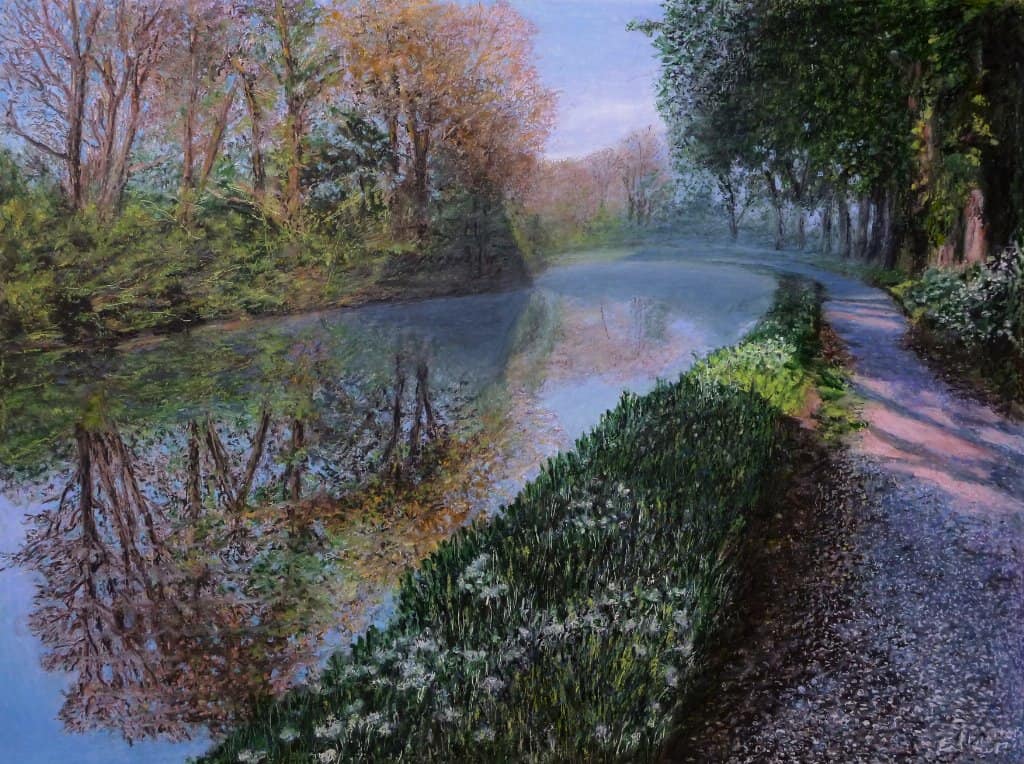
Diana, on the other hand, feels that she started observing nature later on in life. She was 18 when she remembers it first piquing her interest, though Margy reminds her of her childhood in New York City observing the ants on the fire escape, cockroaches on the bannister (though luckily not inside her apartment), and flower pot gardens on the roof of her building. Even in a city not particularly known for its wildlife, Diana still found herself connected to nature. An oil painter, she sets up her easel outdoors and paints the beautiful landscapes and sunlight she finds. Often with the aid of a bug net and sunblock while outdoors, she adds additional detail and finishing touches in her studio. 

Describing the way she paints, Diana explains how she works in multiple layers, sometimes scraping back down to the shadows of the first rough sketch before finally getting things to look just how she sees them in her mind. Carla and Margy relate to these parts of Diana’s process, as they both work in layers as well. Often, Carla will decide that a sculptural element isn’t quite working, and she’ll find herself cutting and recutting paper to create a multitude of complex designs that coalesce into one seamless piece. Margy loves the ease of working in layers on a computer, allowing her to save different versions of images and come back to them at later times. She has a giant folder of Adobe Illustrator files from her goldenrod series, as she saves every step of her thought process.

Upon hanging the show, Diana suggested that the art be hung all together, as opposed to separating it by artist. This creates an effortless flow through the Gallery. The different mediums complement each other gracefully, and are married by both color and theme. There is an almost accidental Ithaca motif moving throughout the collection. Diana paints landscapes of the surrounding Ithaca area, Margy’s insects are local to Ithaca goldenrod, and some of Carla’s creatures, such as the ladybug and great blue heron, are native to the area as well. Paired with in depth descriptions, viewers can learn more about the mimicry in the insect community, the history of land use in Ithaca, and literary allusions to the connection between humans and nature.

Carla’s views “Wings, Petals, and Leaves” as an invitation to come closer and look at nature with a different eye. Notice what is easily overlooked, and think about your place in the world. Diana wants people to know that there are really beautiful settings all around us, and many things we can do as individuals to give back to the land that gives so much to us. In Ithaca, we are fortunate to have many land trusts and organizations, such as the Cayuga Bird Club, that work to keep these places preserved. It is also thanks to the generosity of people such as Robert J. Treman and Roy H. Park that many of our gorges are protected, and this generosity is ever present in our community today. Margy hopes visitors will leave this show and look more closely at what’s around them, realizing how beautiful and complex the natural world really is. Diana concludes by sharing her vision of people going out with a lighter heart than they came in with. After talking with these three extraordinary women, I feel immensely lighter myself. And ready for a hike.

Artistic Process Series: “Double Vision”

The signs of spring in Ithaca are popping up on every corner. Crocuses have defiantly pushed their way up through the earth, bulky jackets have been shed, and the Farmer’s Market is open at Steamboat Landing once again. In the window of the State of the Art Gallery, a pairing of bright sunflowers invites eager viewers inside. These flowers, one painted, the other photographed, set the tone for an equally warm and renewing show. “Double Vision”, by Ileen Kaplan and David Watkins, is a triumphant collaboration, four years in the making.

For both Ileen and David, art was something they stumbled upon later in life. The moment Ileen decided to take up painting was during a trip to Bavaria with her husband in 1998. It was sunrise, and they were strolling through a beautiful field when she heard a voice say to her “you can paint this.” Never having any mystical or spiritual experience this tangible before, Ileen was shocked and excited. She shared this with her husband, an artist himself, and for Christmas that year he bought her paints. Before this divine intervention of sorts, she had never really thought about painting. 

David, on the other hand, was surrounded by art for so long that it was only a matter of time before he built his own practice. He majored in graphic design in college, spent years designing magazines and books, then eventually worked at Cornell University as the graphic artist in their television center. In his various roles at the university over the years, he worked with many artists, writers, and designers and along the way picked up a camera to use for documentation purposes. He was the butt of the typical joke that if he went on vacation with his camera, he had to come home and look at the pictures he’d taken to find out where he’d been. It wasn’t until he received a digital camera and printer as a retirement gift that he began using the camera as an artistic tool, not just a recording device.

Over time, in their respective mediums, both artists became members of the gallery. David remembers himself and his wife being immediately captivated by Ileen’s work when she was applying to join. Both were influenced by each other’s art over the years, admiring each other’s unique use of light and color. 

They began kicking around the idea of curating a two-person show around four years ago. Due to the nature of the gallery’s calendar, coordinating a month where they would both be eligible to hang an exhibit together proved to be a bit of a challenge. But through careful planning, they were able to make the dates finally align, and could begin preparing. 

Ileen and David approached this exhibit through a unique partnership. Ileen was heavily influenced by a show in the Baltimore Museum of Art where a curator had paired Richard Diebenkorn and Henri Matisses’ paintings together to illustrate how the latter’s work had inspired the former’s. Ileen thought the pairing was fantastic. She would often see David’s work hanging in SOAG and think “I could do a great painting off of that!”. She pitched the idea of creating a show inspired by one another’s work to David, and he was sold. He has always loved when the gallery curated exhibitions based on a theme, welcoming the challenge of working within new boundaries. This felt like an extension of that concept, and he was eager to get started.

Finding a common theme for the exhibition wasn’t a challenge for these creators, as both are already inclined toward nature. David primarily shoots botanicals and landscapes and refers to himself as a “lazy photographer” due to how readily accessible his subject is – the garden right outside his house. Ileen confirms that his perennial garden is unbelievable, and the floral arrangements he grows to photograph are a testament to his green thumb. Ileen’s work is similarly nature-oriented, focused keenly on how light affects subjects, and utilizing a color palette that David boasts is “second to none in the gallery”. As easy as it was to find their topic, the challenge arose when they began contemplating how to create the show itself.

Painting based on a photograph is one thing, as many painters are known to create works by looking at reference images for direct inspiration. Ileen was captivated by the vibrant colors of many of David’s pictures and found ways to incorporate them into her palette while abstracting his subject matter. Capturing a photograph based on a painting, however, requires an entirely different skillset, and a touch of serendipitous luck. David approached this endeavor in two different ways. First, he would use one of Ileen’s paintings as a jumping-off point. Then, he scoured his more than 45,000 digital images to find pictures that matched up with the painting. The second, bigger challenge, was referencing a painting and setting out to take a photograph that pairs well with it. To do this, he began by breaking down the painting into elements. What is the lighting doing? What about the lines? The patterns? Is there something he could find in nature that could work with that? He didn’t strive for mimicry but instead sought out compatible pairings.

One such image was presented to him in the early morning as he stood by Eagle Lake in Maine. Having been working on the show for quite a few months now, he could easily call Ileen’s paintings to mind and often found himself searching for her colors in nature. The way the sun reflected on the pond reeds that morning lit them in a dreamy pink hue, and he was delighted by how similar the coloring was to her painting “Pink Sky”. He captured the image “Reeds and Reflections in Shallow Green Water”, which illuminates the beauty that can be discovered through being inspired by another artist’s work. 

An additional unexpected creative merging came when David had the idea to use one of Ileen’s paintings, with her permission, as a textured background in Photoshop and merged it with one of his photographs. Her painting “Winter on the Lake”uses a cool palette to highlight the complex beauty of winter’s still grayness. Layered with David’s “Two Green Benches”, an image captured during a blizzard on the shore at Stewart Park, the collaged piece becomes a conversation between stormy solitude and hopeful snowy reflections.

Now that the show is hung and completed, the duo is pleasantly surprised by how well it all came together. In the months leading up to its opening, they had only seen two pieces paired side by side. Ileen wondered how the end result would look, and when they stepped back to admire their work, they realized that their worries had all been for naught. The show they had waited years to create was finally complete.

“Double Vision” is on view at the State of the Art Gallery from now until May 1st.

Artistic Process Series: Patricia Brown

Patricia Brown and I sit across from each other in her new art studio. The unique room, used as a hair salon by the previous homeowner, has a bathroom, a plethora of storage, and a separate entrance from the rest of the house. Drawers of collage scraps are labeled “animals”, “people”, and “multi-colored patterns”. Tubes of acrylic paint are sorted by color, a bookcase houses more sketchbooks than I’ve ever seen. Adjustable spotlights cast a comforting glow over the space, illuminating paintings in progress, and finished pieces adorning the walls. It is one of the coolest rooms I have ever set foot in. 

In the February show “Awakenings”, Patricia’s work spans two different walls in the gallery. The first, nestled right inside the front window, is titled “Love.” She kept the scale of the series small as she was in the process of moving, and didn’t have the space to create anything larger. During Covid quarantine, she made over 200 collages. They were abstract, nothing realistic about them, she didn’t want to deal with subject matter or the world. Then in the winter of 2021, her abstract pieces started featuring hearts, a theme that would trend throughout February. A selection of these bright and hopeful pieces sets a tone of optimism and light that pierces the Ithaca winter and invites patrons in from the bitter cold. 

This show inspired her second series, titled “Retreat”.

Moving from her house of 30 years where she raised her kids, Patricia realized that a house and a home are two different entities altogether. A house is a building that you move into, and if you’re lucky, it can become your home. She’s lived in places that have never become her home. She was very conscious of this as she moved into her new house and intentionally began to lay the groundwork for making this house a home. 

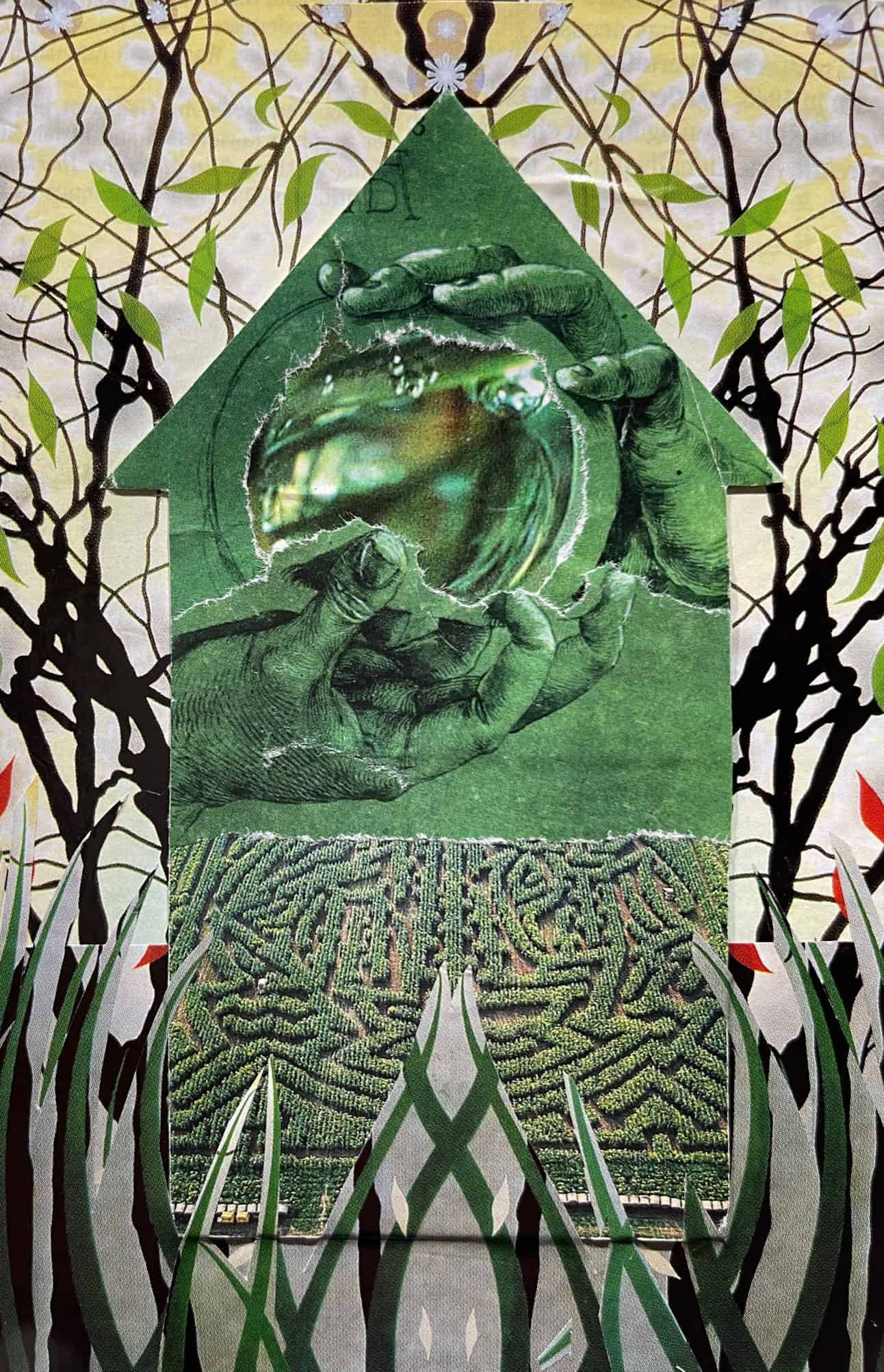
Through her artwork, she explored this concept, making little house collages. Some abstract, some subject-based. She worked on the idea in different mediums, making a painted paper sculpture of tiny houses, before returning to the original collage format. The first piece in the series just came to her. She didn’t plan it, she didn’t edit it, she just let it happen. There wasn’t much meaning to it, she was just trying to break out and play. This got her thinking about the concept of above and below, first floor and second floor, which gave her a lot more to play with. Pairing opposites, pairing similarities. She would find textural similarities and then take a step back and start thinking “what could it mean?”. She pursued the themes of doors, portals, and included images of art she loves. It’s her way of paying homage to artists who have impacted her. 

She began setting the houses in landscapes, giving them a place to reside. There are similar color and textural themes that marry the house and the outside world, sometimes there are symbolic reasons for the background, and other times it’s based on trying out a myriad of different images and seeing what blends well. They are rooted in place and memory. Different subjects remind Patricia of art galleries she’s visited, and one piece even includes an old postcard of a spiral staircase from a bed and breakfast, the Rose Inn, that burned down 22 years ago. 

When sourcing collage material for this series, Patricia pulled from her collection of images she has been amassing for over thirty years. Following college graduation, she tried to figure out what kind of art she liked, separate from the art her teachers or art history told her to like. She began compiling scrapbooks of images of art that inspired her. Some of the images for the “Retreat” collages came from these scrapbooks.

At the beginning of this series, she had no idea it would ever turn into a show in the gallery. It was quarantine; she couldn’t find it in herself to make big conceptual pieces, and was having enough trouble finding happiness in daily life. So, she would just do a little something each day to keep herself thinking about design elements. Focusing on color, texture, and light was a great escape from the monotonous and repetitive daily life, she found. She didn’t have any pretense, it wasn’t intentional, but as she created more pieces and hung them on her studio wall, she suddenly realized- this was it. This was her next show.

Patricia doesn’t think she’s done with the idea of house and home. She’s started painting again, now that her studio space is functional, well lit, and ready to feel like home. She’s wondering to herself- “What’s going to be my next thing?”. It hasn’t come yet, but it will come. It always does.

Artistic Process Series: Ed Brothers

Sunlight streams through the window, streaking the pale wooden floor with shadows. The bell chimes above my head as I cross the threshold, leaving behind the biting February wind and breathing in deeply the smell of stillness and contemplation.

It’s Friday at the State of the Art Gallery, and I have just arrived for my five hour shift. Hanging my coat on a nail in the installation supply closet, I pull an extra chair up to the desk and begin chatting with Ed Brothers. It’s our first time sitting together, and I am eager to pick his brain about the work he has displayed in the current show, as well as ask for his help on a project or two.

For my final semester of senior year at Ithaca College, I have the opportunity to intern at SOAG. Working at SOAG has introduced me to the inner workings of a collaborative gallery space. I’ve attended monthly membership meetings, assisted the marketing committee, and helped spot the most recent installation (“spotting” is a term I just learned -it’s when you figure out where different pieces should be hung in a show and involves lots of discussion about space, sizing, color, and thematic flow). These tasks have revealed to me that this is the exact type of work I am interested in pursuing in the future and have laid the groundwork for an enlightening and joyful semester.

Patrons sporadically stream in and out of the gallery. The winter chill has turned many away from roaming the Ithaca Commons, and Ed and I reminisce, dreaming of beautiful blue spring days where I can hike and Ed can fish again. Our conversation today revolves around the artistic process, a topic I have long been fascinated with. An amateur artist myself, I am often frustrated by my lack of motivation to create. It is so seldom that I am bit by the bug of creativity, dropping everything in my midst to make a collage, or draw in my sketchbook. In the presence of such prolific and accomplished artists like Ed (who once won first place in the non-professional chapter of the global Oil Pastel Society competition), I intend to pick their brains for every piece of wisdom I can gather about keeping up a routine and intentional artistic practice.

When Ed paints, he works from reference photos he has taken at different places or of people he feels deeply connected to. Since honing his craft, he’s realized that he observes the world differently, seeing things in a different light – literally. He is more cognizant of composition as he hikes through the woods or gazes at the ripples in a river, taking care to frame his photos so he has a dynamic image to paint from later down the line. One part of Ed’s process that I find particularly inspiring is his dedication to his craft. Sometimes it takes him a while to decide what he is going to paint, but once he sets his mind to it, he will finish it. He has never started a project and abandoned it, never deemed a piece unworthy halfway through and scrapped it. Because of this, it can take him a while to decide on his next artistic endeavor. But once the photo is chosen, cropped, and ready, there is no turning back.

This steadfast tenacity, ability to put his mind to something and see it through to the bitter end, is an extremely admirable part of Ed’s work. Aside from this, his attention to detail -no doubt stemming from his background in microscopy – requires a great deal of patience and perseverance. The work that results from this level of concentration is technically advanced and visually exquisite. In his current body of work in the February member show, take a moment to note what year each piece was created. When you pay attention to this timeline, a story of his artistic career unfurls before you. His mastery of pastel technique is revealed, and you find yourself falling even more in love with pieces you thought you already understood. 

Talking with him is a masterclass in how attentive work can create a cathartic experience of reflection, bringing one back to a time and place they love. Ed’s pieces are rarely available for sale, as he finds that he becomes attached to them through the laborious process of creating them, often spanning weeks and months. His process inspires me to take a closer look at the places I frequent, and take time to see the beauty in the details of life.