Category Archives: Awakenings

Artistic Process Series: Patricia Brown

Patricia Brown and I sit across from each other in her new art studio. The unique room, used as a hair salon by the previous homeowner, has a bathroom, a plethora of storage, and a separate entrance from the rest of the house. Drawers of collage scraps are labeled “animals”, “people”, and “multi-colored patterns”. Tubes of acrylic paint are sorted by color, a bookcase houses more sketchbooks than I’ve ever seen. Adjustable spotlights cast a comforting glow over the space, illuminating paintings in progress, and finished pieces adorning the walls. It is one of the coolest rooms I have ever set foot in. 

In the February show “Awakenings”, Patricia’s work spans two different walls in the gallery. The first, nestled right inside the front window, is titled “Love.” She kept the scale of the series small as she was in the process of moving, and didn’t have the space to create anything larger. During Covid quarantine, she made over 200 collages. They were abstract, nothing realistic about them, she didn’t want to deal with subject matter or the world. Then in the winter of 2021, her abstract pieces started featuring hearts, a theme that would trend throughout February. A selection of these bright and hopeful pieces sets a tone of optimism and light that pierces the Ithaca winter and invites patrons in from the bitter cold. 

This show inspired her second series, titled “Retreat”.

Moving from her house of 30 years where she raised her kids, Patricia realized that a house and a home are two different entities altogether. A house is a building that you move into, and if you’re lucky, it can become your home. She’s lived in places that have never become her home. She was very conscious of this as she moved into her new house and intentionally began to lay the groundwork for making this house a home. 

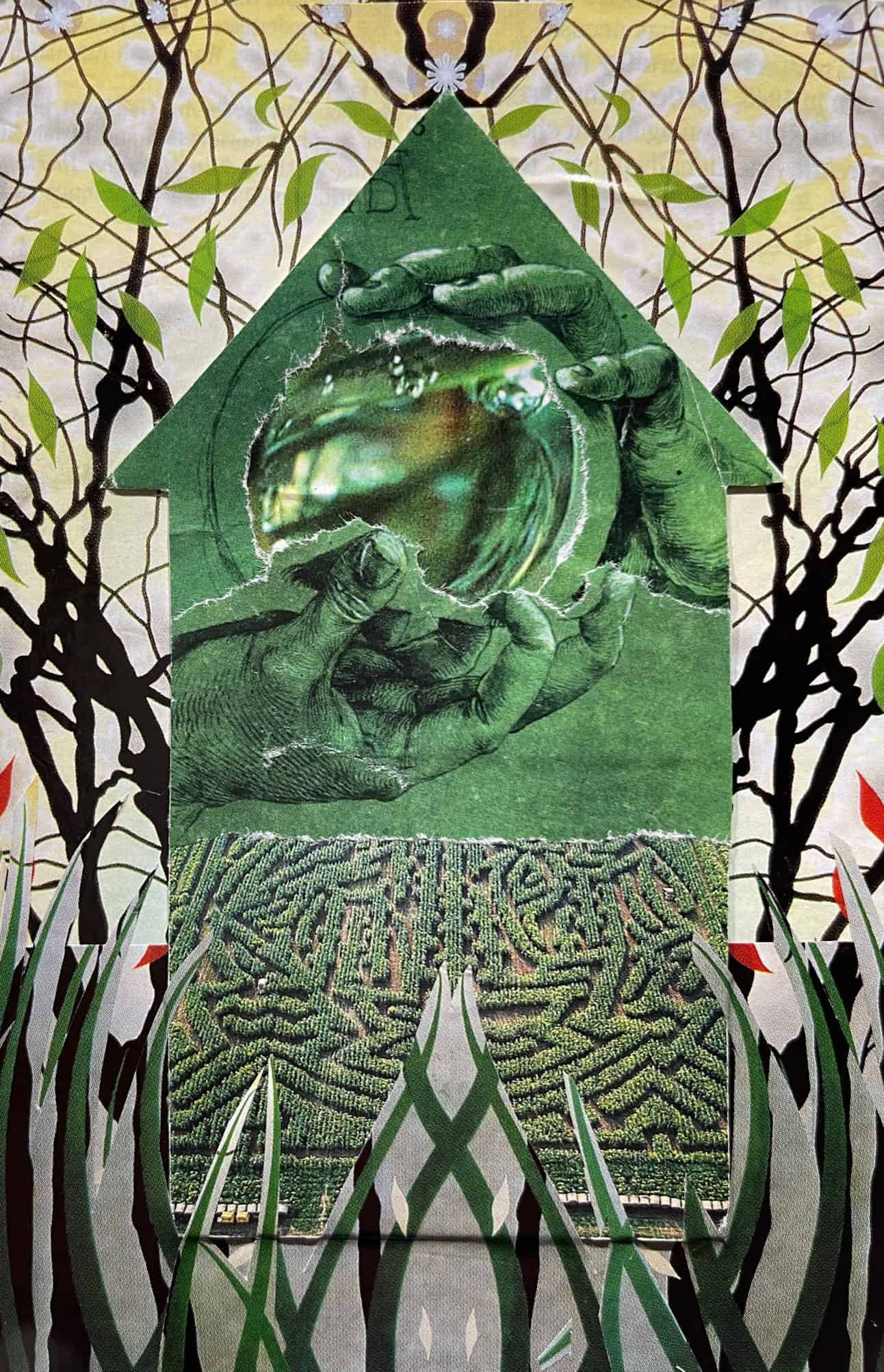
Through her artwork, she explored this concept, making little house collages. Some abstract, some subject-based. She worked on the idea in different mediums, making a painted paper sculpture of tiny houses, before returning to the original collage format. The first piece in the series just came to her. She didn’t plan it, she didn’t edit it, she just let it happen. There wasn’t much meaning to it, she was just trying to break out and play. This got her thinking about the concept of above and below, first floor and second floor, which gave her a lot more to play with. Pairing opposites, pairing similarities. She would find textural similarities and then take a step back and start thinking “what could it mean?”. She pursued the themes of doors, portals, and included images of art she loves. It’s her way of paying homage to artists who have impacted her. 

She began setting the houses in landscapes, giving them a place to reside. There are similar color and textural themes that marry the house and the outside world, sometimes there are symbolic reasons for the background, and other times it’s based on trying out a myriad of different images and seeing what blends well. They are rooted in place and memory. Different subjects remind Patricia of art galleries she’s visited, and one piece even includes an old postcard of a spiral staircase from a bed and breakfast, the Rose Inn, that burned down 22 years ago. 

When sourcing collage material for this series, Patricia pulled from her collection of images she has been amassing for over thirty years. Following college graduation, she tried to figure out what kind of art she liked, separate from the art her teachers or art history told her to like. She began compiling scrapbooks of images of art that inspired her. Some of the images for the “Retreat” collages came from these scrapbooks.

At the beginning of this series, she had no idea it would ever turn into a show in the gallery. It was quarantine; she couldn’t find it in herself to make big conceptual pieces, and was having enough trouble finding happiness in daily life. So, she would just do a little something each day to keep herself thinking about design elements. Focusing on color, texture, and light was a great escape from the monotonous and repetitive daily life, she found. She didn’t have any pretense, it wasn’t intentional, but as she created more pieces and hung them on her studio wall, she suddenly realized- this was it. This was her next show.

Patricia doesn’t think she’s done with the idea of house and home. She’s started painting again, now that her studio space is functional, well lit, and ready to feel like home. She’s wondering to herself- “What’s going to be my next thing?”. It hasn’t come yet, but it will come. It always does.
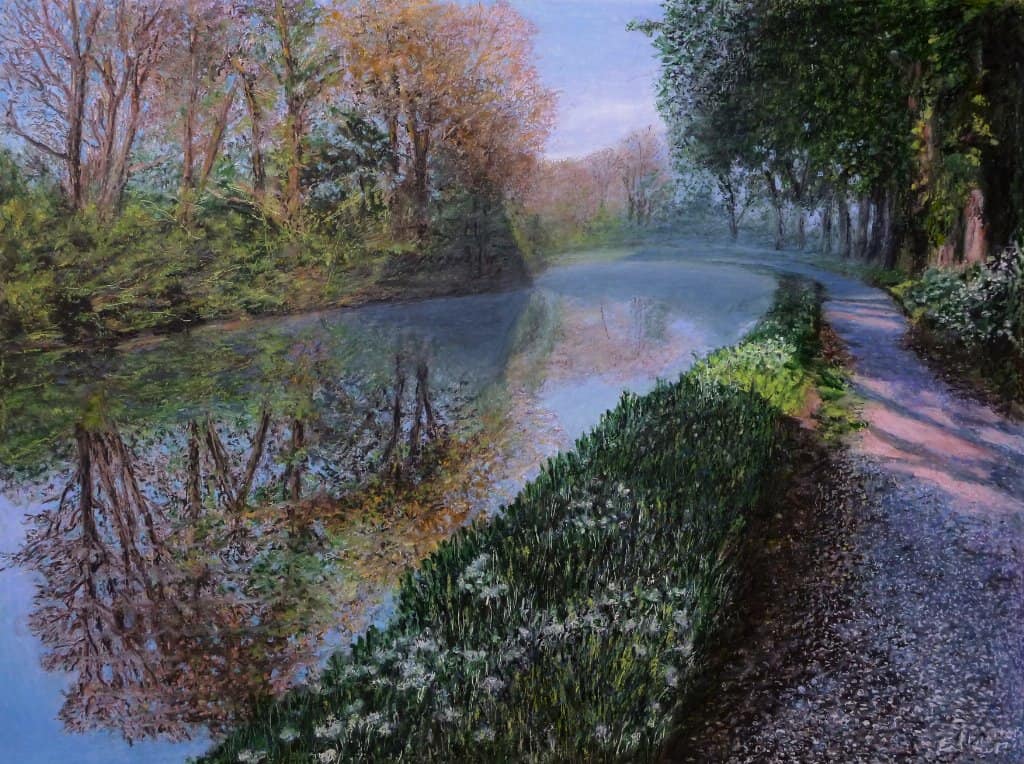
Artistic Process Series: Ed Brothers

Sunlight streams through the window, streaking the pale wooden floor with shadows. The bell chimes above my head as I cross the threshold, leaving behind the biting February wind and breathing in deeply the smell of stillness and contemplation.

It’s Friday at the State of the Art Gallery, and I have just arrived for my five hour shift. Hanging my coat on a nail in the installation supply closet, I pull an extra chair up to the desk and begin chatting with Ed Brothers. It’s our first time sitting together, and I am eager to pick his brain about the work he has displayed in the current show, as well as ask for his help on a project or two.

For my final semester of senior year at Ithaca College, I have the opportunity to intern at SOAG. Working at SOAG has introduced me to the inner workings of a collaborative gallery space. I’ve attended monthly membership meetings, assisted the marketing committee, and helped spot the most recent installation (“spotting” is a term I just learned -it’s when you figure out where different pieces should be hung in a show and involves lots of discussion about space, sizing, color, and thematic flow). These tasks have revealed to me that this is the exact type of work I am interested in pursuing in the future and have laid the groundwork for an enlightening and joyful semester.

Patrons sporadically stream in and out of the gallery. The winter chill has turned many away from roaming the Ithaca Commons, and Ed and I reminisce, dreaming of beautiful blue spring days where I can hike and Ed can fish again. Our conversation today revolves around the artistic process, a topic I have long been fascinated with. An amateur artist myself, I am often frustrated by my lack of motivation to create. It is so seldom that I am bit by the bug of creativity, dropping everything in my midst to make a collage, or draw in my sketchbook. In the presence of such prolific and accomplished artists like Ed (who once won first place in the non-professional chapter of the global Oil Pastel Society competition), I intend to pick their brains for every piece of wisdom I can gather about keeping up a routine and intentional artistic practice.

When Ed paints, he works from reference photos he has taken at different places or of people he feels deeply connected to. Since honing his craft, he’s realized that he observes the world differently, seeing things in a different light – literally. He is more cognizant of composition as he hikes through the woods or gazes at the ripples in a river, taking care to frame his photos so he has a dynamic image to paint from later down the line. One part of Ed’s process that I find particularly inspiring is his dedication to his craft. Sometimes it takes him a while to decide what he is going to paint, but once he sets his mind to it, he will finish it. He has never started a project and abandoned it, never deemed a piece unworthy halfway through and scrapped it. Because of this, it can take him a while to decide on his next artistic endeavor. But once the photo is chosen, cropped, and ready, there is no turning back.

This steadfast tenacity, ability to put his mind to something and see it through to the bitter end, is an extremely admirable part of Ed’s work. Aside from this, his attention to detail -no doubt stemming from his background in microscopy – requires a great deal of patience and perseverance. The work that results from this level of concentration is technically advanced and visually exquisite. In his current body of work in the February member show, take a moment to note what year each piece was created. When you pay attention to this timeline, a story of his artistic career unfurls before you. His mastery of pastel technique is revealed, and you find yourself falling even more in love with pieces you thought you already understood. 

Talking with him is a masterclass in how attentive work can create a cathartic experience of reflection, bringing one back to a time and place they love. Ed’s pieces are rarely available for sale, as he finds that he becomes attached to them through the laborious process of creating them, often spanning weeks and months. His process inspires me to take a closer look at the places I frequent, and take time to see the beauty in the details of life.

Five Years in Laos

After graduating from Cornell in 1965, I chose to volunteer with International Voluntary Services (precursor to Peace Corps) and to go to Laos to work with villagers. What an adventure half-way around the world, with several opportunities to travel and 5 years to experience the culture of Southeast Asia.

While there, I learned how to do Batik from a fellow American.  I purchased China silk from the market and my parents sent me Rit dye and paraffin.  Three of the pieces here represent batik, two being mine and one being from a trip to Ceylon (Sri Lanka).

Thai temple rubbings were abundant and provided some models for making some of my own art.  In this collection is a Thai dancer carved into a door panel and then painted.

The Cambodian rubbing shown here in part was given to me by a friend who visited Cambodia. At that time, my passport did not allow me to visit that country to view in person the magnificent Angkor Wat. The original rubbing is over 8 feet wide and is mounted on my Livingroom wall.

The Lao dolls were made by a local Laotian woman and reflect several minority women living in Laos. The population in Laos is comprised of over 40 ethnic groups.  One particular ethnic group, the Hmong, lived in the hills of Northeast Laos and were very involved in the Vietnam War and the Secret War in Laos.  Those were unsettling times!

Buddhism was the major religion of Laos and Thailand, with many Buddha temples and images.  The image of the Buddha head here is from a metal sculpture obtained in a tourist shop in Vientiane Laos. Perhaps it originated from Thailand over the years and provided good income for the shopkeepers.

These images are my contribution to the group show entitled “Awakenings”. They “awakened” many memories of adventures from many years ago.

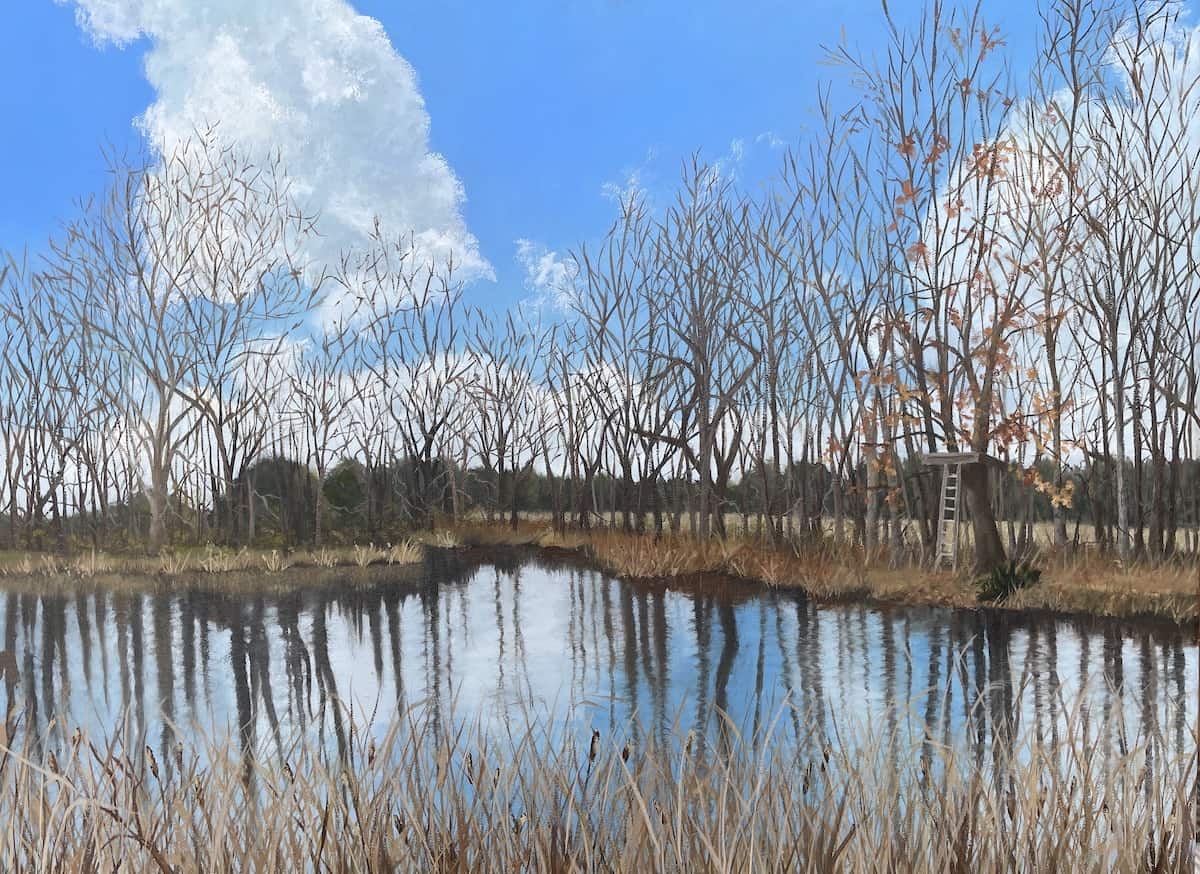
Marvin’s Pond III ~ Between the Seasons – 2022

This body of work that is being shown at SOAG is my attempt to share reflections on certain inspiring locations.  Upon experiencing these locations I realize a kind of awakening that makes me suddenly aware of new light, color, texture, and atmosphere. One such location is my neighbor’s pond, about 200 yards from my house.  It is hidden by a row of locust trees but once you wonder through that privacy, a new world develops, one that changes on a daily and seasonal basis. The walk to the pond travels through my own perennial garden that offers the same experience of awakening with a continual succession of blooms throughout the seasons. This particular painting might be the first painting I’ve ever done without having green dominate and that presented many challenges!

Making Cyanotypes inspired by the Ara Pacis

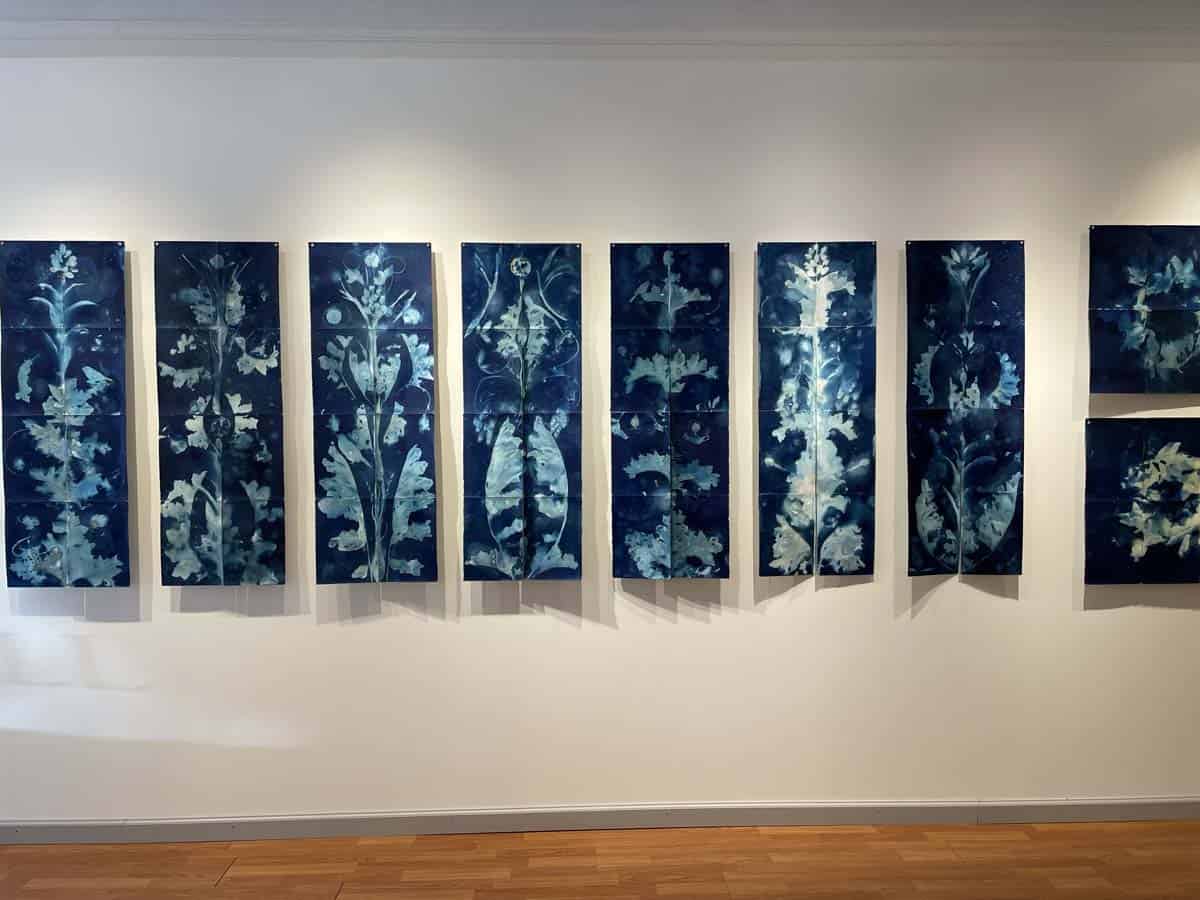
Pax Anthropocene in Awakenings at State of the Art Gallery

The images in Pax Anthropocene are inspired by the Ara Pacis, a monument to peace that was created by Caesar Augustus to designate the beginning of a new era of peace in the Roman Empire. Dedicated in 9 B.C.E., the Ara Pacis Augustae took the form of an open air altar that was decorated with deep reliefs carved into marble. The upper friezes depict a ritual procession showing Caesar Augustus and his family, government officials, and religious figures while the lower friezes are covered in stylized floral scrollwork that is usually interpreted as representing the abundance and fertility that peace would bring to the Empire.

The floral imagery, while highly stylized and fantastical, is also very detailed and numerous flora and fauna from the Mediterranean region have been identified by scholars.

Finding the birds, lizards, scorpions, and various other animals and insects is an entertaining occupation when visiting the monument, which is located in a building designed by Richard Meier along the Trastevere River in Rome, Italy. The nest of baby birds threatened by a snake is a particularly whimsical little vignette.

Greek and Roman sculptors often modeled the vegetal decoration in their works after local species. Acanthus mollis is one of the most famous as the vegetation depicted in Corinthian columns.

https://oddathenaeum.com/acanthus-leaves/

To make the Ara Pacis inspired cyanotypes, I collected local specimens on walks or from florists or produce sellers. I coated the paper with the UV-sensitive cyanotype solution, made arrangements on the paper, then exposed them in sunlight. The changing quality of the natural light, the different watercolor papers available locally, and the dissolved minerals in Rome’s water create some of the tonal variations in the prints.

In total I made seven unique Ara Pacis inspired compositions in Rome and these are vertical images in the Awakenings exhibition at State of the Art Gallery.

Why do I call the series Pax Anthropocene, you might ask? Well, the peace that Caesar Augustus proposed with the Ara Pacis monument is often called the Pax Augusta. Pax is “peace” in latin. The term “Anthropocene” is used by theorists to suggest the current age of human manipulation of the environment. Some place the starting date of the Anthropocene at the lowest point of carbon in the atmosphere, somewhere in the 1700s when colonization reduced human populations in the Americas but before the Industrial age.

The series title Pax Anthropocene is meant to invoke the idea of making peace with nature in our current era, which is in keeping with my recent work about climate change.

You can also see the entire series or my other work on my website.

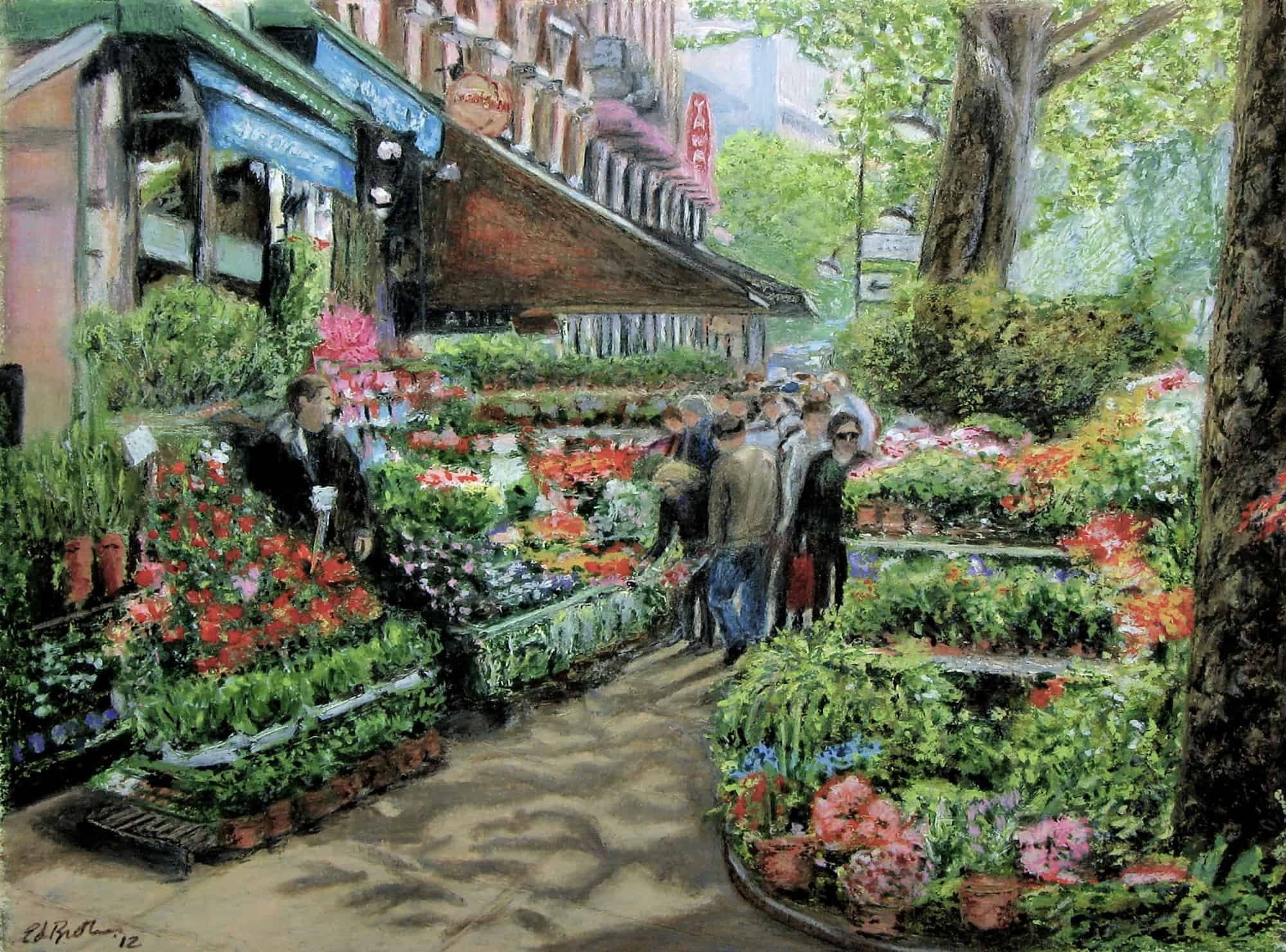
A street corner in Paris

An April vacation several years ago ended with three days in Paris. Among the thousands of photos from that trip, one was bursting with the color of flowers and cried out to be transformed into a painting. The image was taken looking northeast, the Seine and a boulevard was on the right, but the area of interest was a row of flower shops and strollers enjoying the morning sun of spring. A few years after completing the painting I was viewing a digital copy of Woody Allen’s wonderful film, “Midnight in Paris”. The first time I saw it was in a movie theater, but it deserved a second and third look. The opening of the movie is a 1920’s jazz soundtrack with an accompanying series of very quick shots taken around Paris. As I re-watched the opening I thought I saw a familiar view. A screen capture and further inspection confirmed it was the exact corner I had painted and from the same point of view. I was shocked, amazed, and pleased. Further snooping on Street View, Google Earth, and other sources uncovered many other images of the same location in different seasons, times of day and night, and from different points of view. The results of my research is a poor substitute for actual travel, but the latter hasn’t been an option for a couple of years. If I ever make it back to that spot, it’ll almost feel like being home.