Tag Archives: Ed Brothers

Artistic Process Series: Ed Brothers

Sunlight streams through the window, streaking the pale wooden floor with shadows. The bell chimes above my head as I cross the threshold, leaving behind the biting February wind and breathing in deeply the smell of stillness and contemplation.

It’s Friday at the State of the Art Gallery, and I have just arrived for my five hour shift. Hanging my coat on a nail in the installation supply closet, I pull an extra chair up to the desk and begin chatting with Ed Brothers. It’s our first time sitting together, and I am eager to pick his brain about the work he has displayed in the current show, as well as ask for his help on a project or two.

For my final semester of senior year at Ithaca College, I have the opportunity to intern at SOAG. Working at SOAG has introduced me to the inner workings of a collaborative gallery space. I’ve attended monthly membership meetings, assisted the marketing committee, and helped spot the most recent installation (“spotting” is a term I just learned -it’s when you figure out where different pieces should be hung in a show and involves lots of discussion about space, sizing, color, and thematic flow). These tasks have revealed to me that this is the exact type of work I am interested in pursuing in the future and have laid the groundwork for an enlightening and joyful semester.

Patrons sporadically stream in and out of the gallery. The winter chill has turned many away from roaming the Ithaca Commons, and Ed and I reminisce, dreaming of beautiful blue spring days where I can hike and Ed can fish again. Our conversation today revolves around the artistic process, a topic I have long been fascinated with. An amateur artist myself, I am often frustrated by my lack of motivation to create. It is so seldom that I am bit by the bug of creativity, dropping everything in my midst to make a collage, or draw in my sketchbook. In the presence of such prolific and accomplished artists like Ed (who once won first place in the non-professional chapter of the global Oil Pastel Society competition), I intend to pick their brains for every piece of wisdom I can gather about keeping up a routine and intentional artistic practice.

When Ed paints, he works from reference photos he has taken at different places or of people he feels deeply connected to. Since honing his craft, he’s realized that he observes the world differently, seeing things in a different light – literally. He is more cognizant of composition as he hikes through the woods or gazes at the ripples in a river, taking care to frame his photos so he has a dynamic image to paint from later down the line. One part of Ed’s process that I find particularly inspiring is his dedication to his craft. Sometimes it takes him a while to decide what he is going to paint, but once he sets his mind to it, he will finish it. He has never started a project and abandoned it, never deemed a piece unworthy halfway through and scrapped it. Because of this, it can take him a while to decide on his next artistic endeavor. But once the photo is chosen, cropped, and ready, there is no turning back.

This steadfast tenacity, ability to put his mind to something and see it through to the bitter end, is an extremely admirable part of Ed’s work. Aside from this, his attention to detail -no doubt stemming from his background in microscopy – requires a great deal of patience and perseverance. The work that results from this level of concentration is technically advanced and visually exquisite. In his current body of work in the February member show, take a moment to note what year each piece was created. When you pay attention to this timeline, a story of his artistic career unfurls before you. His mastery of pastel technique is revealed, and you find yourself falling even more in love with pieces you thought you already understood. 

Talking with him is a masterclass in how attentive work can create a cathartic experience of reflection, bringing one back to a time and place they love. Ed’s pieces are rarely available for sale, as he finds that he becomes attached to them through the laborious process of creating them, often spanning weeks and months. His process inspires me to take a closer look at the places I frequent, and take time to see the beauty in the details of life.
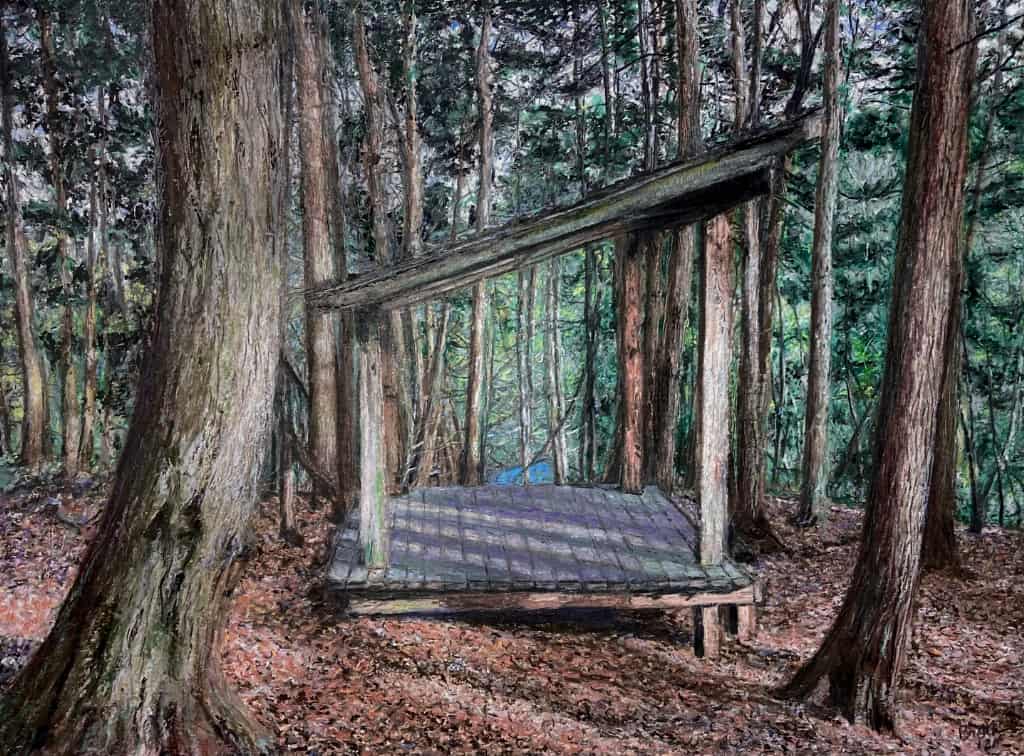
Looking Forward to Spring: Room with a View

It’s not even New Years and I’m already thinking about what my favorite piece of local woods will look like in March. Fortunately a photo I took last year was available for reference, so I fired up the time machine and jumped ahead three months to this spot near the headwaters of Six Mile Creek. This is the general locality that I’ve depicted in four earlier oil pastel pieces. I hike there often and always see something new that excites me. This particular lean-to is the only structure on the entire locality, except for the wooden boardwalk over the marsh upstream. The lean-to has been there many years, likely updated, since my adult children knew about it as favorite spot during their teenage years well before the establishment of the Roy H. Park Preserve in 2007. What attracted me to this composition, both in the photograph and final painting, is the way the lean-to floor, post and slanted roof line neatly frames the view beyond where the creek can be seen below. The lean-to is a non-natural constructed element, but it beautifully blends into the environment. The foreground trees provide a second frame and add to the depth of the piece. I hope you enjoy viewing the painting and maybe I’ll see you at the lean-to next spring.

Another river painting, but minus the river

I completed this piece several years ago, but it’s an obvious addition to our”tree” show. It depicts a view along the Miramichi River (New Brunswick, Canada) where I have fished for salmon for nearly fifteen summers. Our crew of four is fly casting mornings and evenings, but we take a midday break when there’s time for a leisurely stroll on a wooded path not far from the river. The route gives an occasional glimpse of the rapids and pools, but mostly one just hears the river sounds as they travel through the vegetation. This work is one of my favorites, which is surprising since it only took a few days to complete. The process of creating it was almost like the action of a person possessed and obsessed. I can still hear the river when I look at the painting.

Summit at Black Rock

This recently finished oil pastel painting was especially challenging. Faces of people very familiar to me and hands take a lot of trial and error. The small size I work (8.5″ x 11.5″) makes it worse of course. I’m calling this finished for now, but there are still a few things which may get tweaked (again!) down the line.  The subjects are four fishing guides in New Brunswick, Canada; at a camp I’ve visited every summer for 15 years. The border was closed in 2020 and this year may be another miss. I have my fingers crossed that a vaccination may be an entry ticket. Some of these guides have been doing that hard work for fifty years.  They pole a single angler in 15 ft canoes up and down a mile of tumbling, rocky, private water.They really know the salmon and the river and are a pleasure be with.  This is my ninth painting of the area. I hope to get there in the autumn some time to incorporate the colorful foliage.

Ants on a Log: new painting or healthy snack?

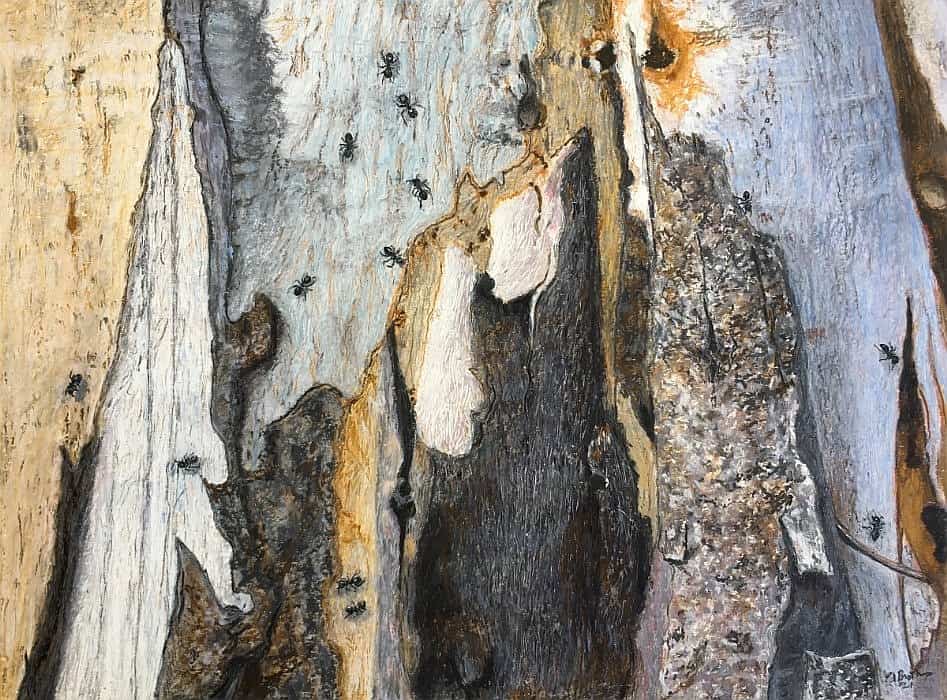
My immediately preceding painting was a detailed street scene with lots of straight line features and strong perspective demands. I needed a break so I chose to do something very different, sort of a “palette cleanser” (pun intended).  I settled on a photo I took a year ago while visiting friends in Tasmania. The eucalyptus pictured is right near their front door and the ant infestation was so fascinating I took snaps almost every time I passed it. Sadly, I just found out that the tree needs to be cut down.  This is my memorial. My alternative title is “Waiting for Dali”.

The Visitor

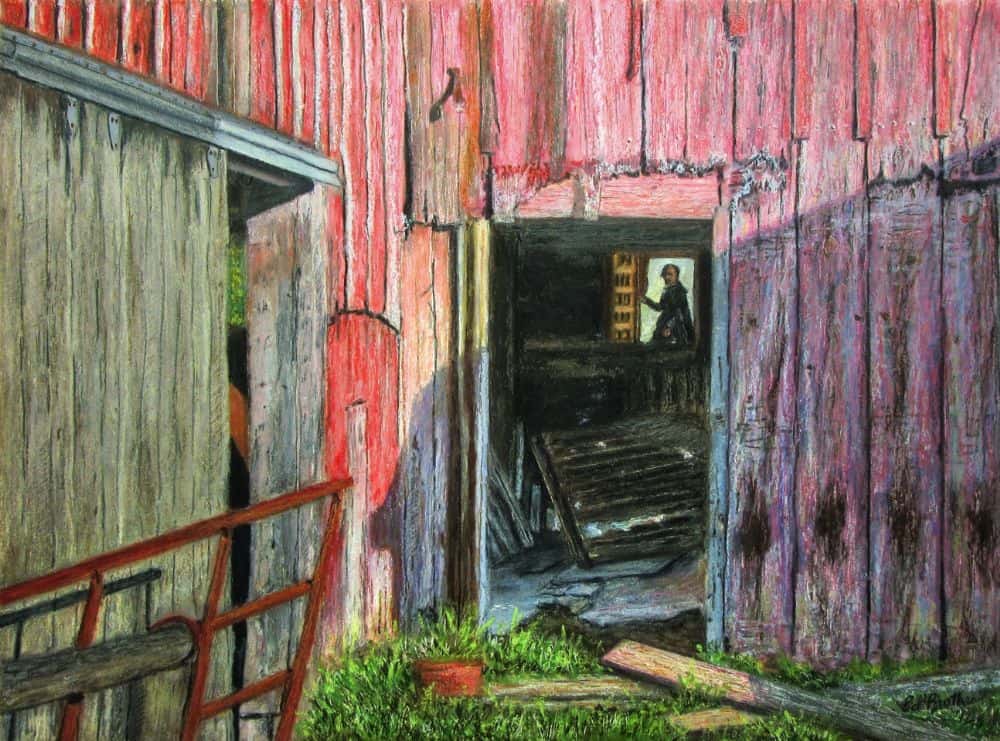
This is my second painting of a local barn and it features a closer look through an open doorway. The composition was not altered from how it appeared in my reference photograph, but fortuitously three significant diagonal features, the rusty gate, the top of the left doorway, and the shadow line from the right, all converged on the open illuminated window visible within the barn. In my photo, there was only some green weeds present beyond the window. This seemed inappropriate for a focal point of the image, so I pondered with playing around and considered a fanciful addition. Maybe some memories from an art history class many years ago sparked a realization that the placement of the open window resembled a feature in the Velázquez’s masterpiece “Las Meninas” (The History and Mystery of ‘Las Meninas’ by Diego…) . I knew immediately that the mysterious figure in the doorway of his painting belonged my in barn window. I was very pleased with the addition, and after the painting was completed I did a search to see whether my inclusion of the doorway figure was original. Of course it wasn’t. I must have had subliminal memories of other artists (Picasso, and Dalí in particular) using a Las Meninas theme, composition and figure(s) in their own paintings. In fact, there is an incredibly rich history of many artists doing this (covers & citations » Diego Velázquez, ‘Las Meninas,’ 1656). I guess it’s difficult to be original these days, but I’m happy to be a very small part of an artistic tradition.

Intersections

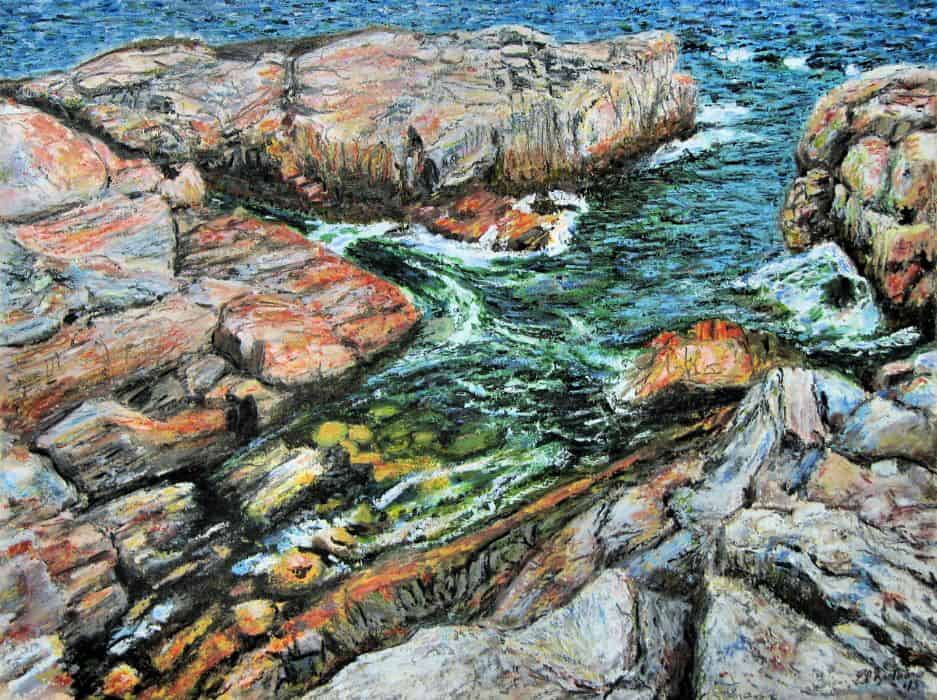
Intersections, as I use the word here, refers to cross-connections between locations such as streets, or larger categories such as islands. It can also refer to the connections, intentional or otherwise, between artists. This post will connect five images from different times and places. The painting shown above is of a location on Appledore Island, Maine. This small island is the site of the Isles of Shoals Marine Laboratory which is an educational and research facility now jointly operated by Cornell University and the University of New Hampshire. Appledore Island also has a rich history in the late 19th century as a summer gathering place for artists, including the American Impressionist Childe Hassam. I’ve always had a fondness for Hassam’s cityscapes and seascapes. I was fortunate to make many trips to Appledore while I was teaching at Cornell. When I started doing oil pastel paintings about 15 years ago, I had the thought that I’d try my hand at an Appledore seascape, but it took me many years to get around to it and also obtain a reference photo to my liking which was produced on my last trip to Appledore. While working on the painting, I made a conscious effort to loosen my technique to pay homage to Hassam’s style of brushwork. The painting title is an expression of that effort.

A couple of years ago I decided to determine the exact island location I photographed and painted, but more importantly, determine whether Hassam had painted the same spot. I enlisted the help of a friend (Dr. Hal Weeks) who has taught on Appledore for many years and has also catalogued all of the island locations of Hassam’s paintings. This was a painstaking effort, but the results were included in a museum show a few years ago. Hal’s determination was that the location I painted is a geological feature now known as Broadway and 42nd Street. This is not a name used in Hassam’s time. It also turned out that Hassam painted the same area (although from a different point of view) and called it “The South Gorge”. Here is his painting and a recent photograph for comparison.

Now it gets interesting. Hassam painted many cityscapes, including some very well-known ones, in New York City. One is titled “Broadway and 42nd Street.” Here it is:

Just to complete the circle in this discussion, I did a cityscape a few years before the Appledore painting. The location is NYC and it shows the intersection of Broadway and Spring Street. Too bad I didn’t chose a location further uptown.

Friends Until the End

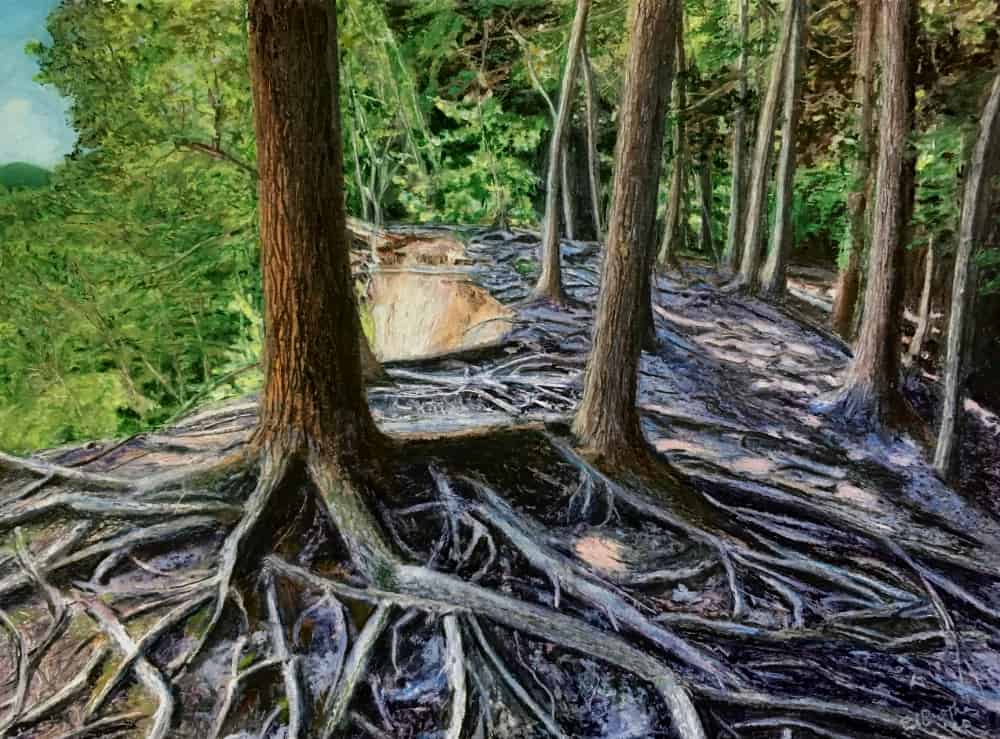
I had a difficult time deciding on a title for this new painting. Some of you might recognize the location as a Fall Creek cliff near Varna. I’ve walked past this spot many times, but the lighting on one particular day highlighted the complex root pattern in a way I knew I had to paint. Trees are now thought to communicate (“The Hidden Lives of Trees, What they feel, How They Communicate” by Peter Wohlleben) via chemicals, hormones, and electrical signals produced by fine root structures (mycorrhizal network) and associated fungi. It’s a form of social network on the “wood-wide web.” If you’d like to learn more, read the book or a shorter descriptive article in Smithsonian Magazine (https://www.smithsonianmag.com/science-nature/the-whispering-trees-180968084/). Of course, the active elements in this web are subterranean, but the exposed roots here are intriguing as an artistic element. I also found the drama of the scene compelling. These trees are on edge of a cliff, and some are already beginning their descent to the creek bed. The life of these trees are already beginning the final lean over the precipice, eventually to be followed by a swift tumble to the waters below. Roots are a metaphor for history and stability, but this scene illustrates that a process is already in progress which cannot be resisted indefinitely.

A Vision of the Past Renewed

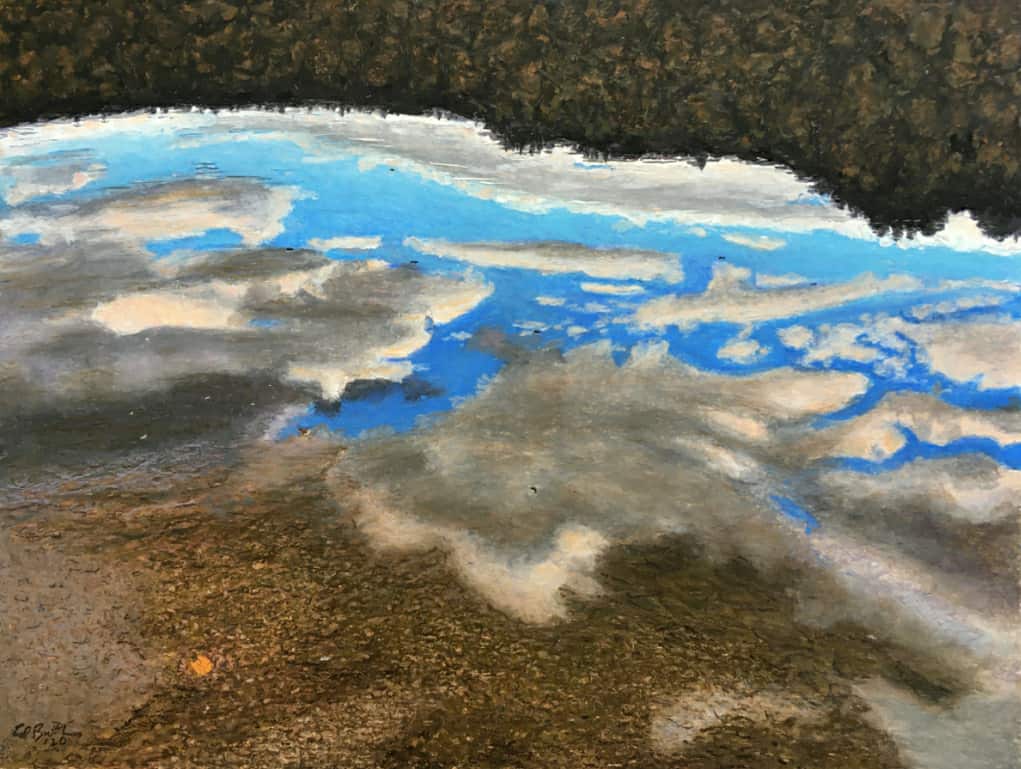
The title of the new painting is HDT Vision. It’s a late day autumn view of Walden Pond from a few years ago. Now you know what HDT means. It turned out that the image looks equally pleasing when inverted, if you can tolerate gravel falling out of the “sky”. I’m always attracted by ambiguity and the possibility of alternative interpretations. Having cloud reflections floating on the water surface with the pond bottom peaking through and no direct view of the land-sky interface adds to the mystery of what’s going on. I also apparently I have a predilection for blue streaks, as this painting, several past ones, and some planned future ones highlight prominent, intense, blue features.

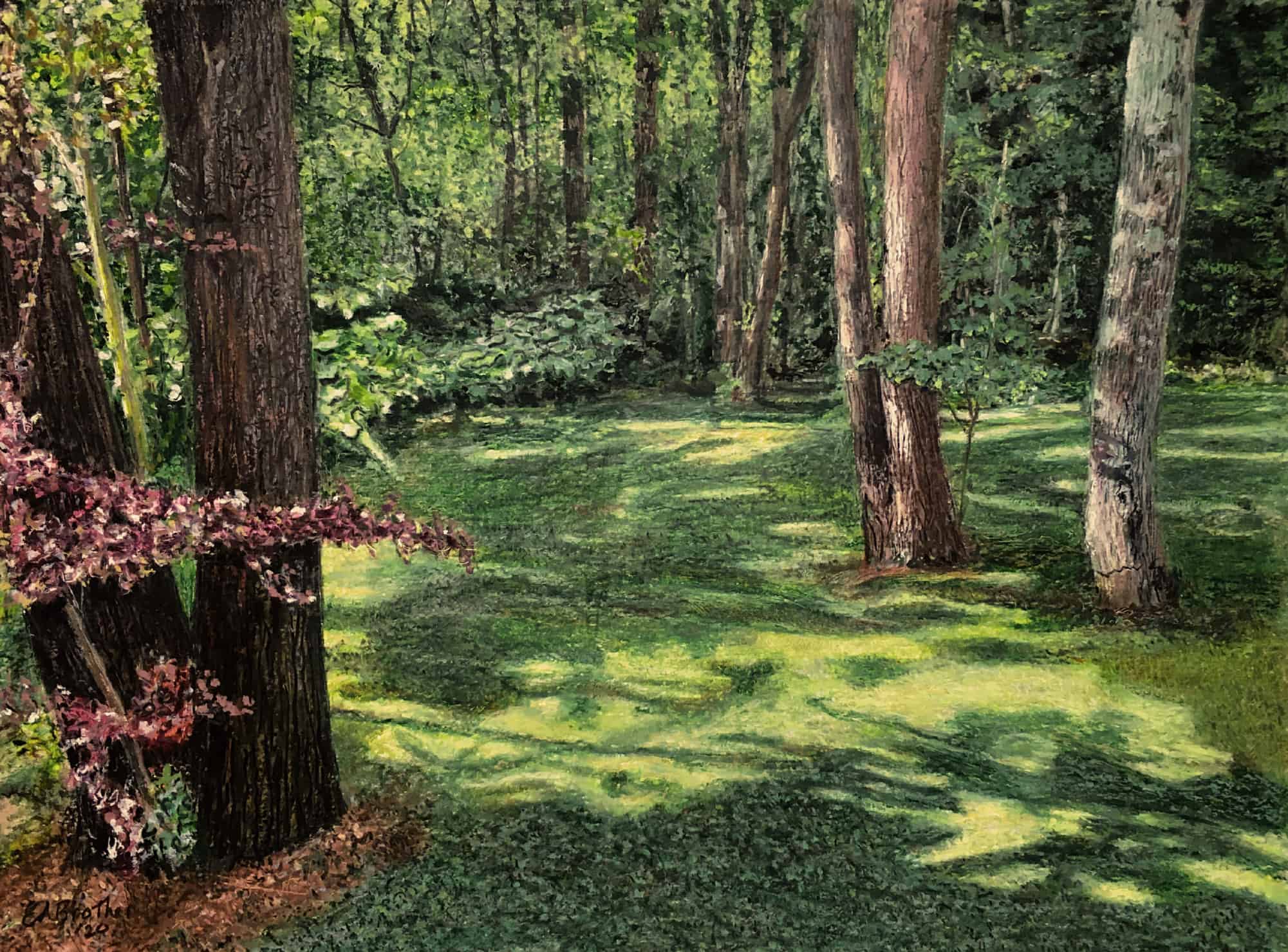
Summer

This recently completed painting is the third in a series of seasonal backyard views at our house. All of the views are sunlit in the early morning. Comparing summer, winter and autumn shows the obvious changes in vegetation, but also variation in the angle of the sun (and shadows) through the year. Nearly ten years have passed between the painting of the winter view and the summer view. New growth and loss of trees are seen when comparing the paintings.