This blog post is a sample from my first book. I will presenting other samples over the next few weeks in conjunction with my show, Making Connections: One Step at a Time. This two person show also features work by photographer Susan C. Larkin.
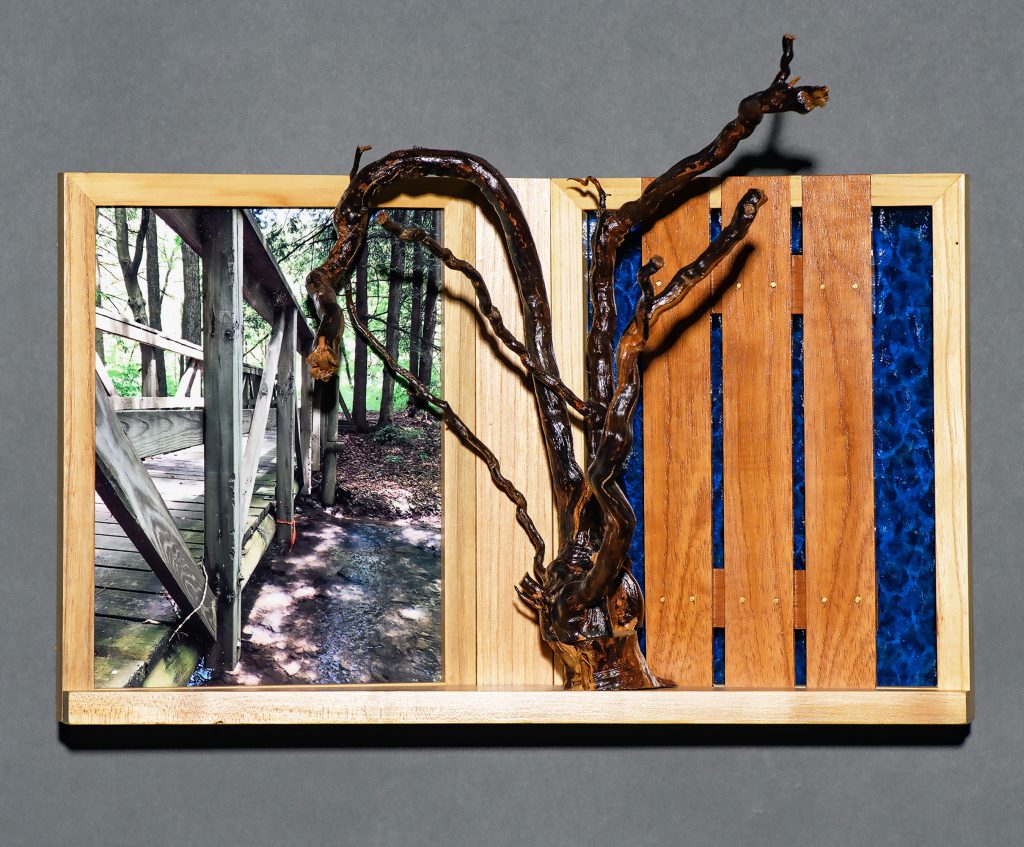
Stream Crossings – 2019
photo, found and reused wood, acrylic sheet
14 x 19 x 9 inches
During the Finger Lakes Spring Conference in 2019, I spent three days with friends hiking the western end of the Trail in Allegany State Park. It had been a rainy season, so we were trekking through a lot of mud and across streams of various sizes. At one point we crossed a wooden bridge spanning twenty or thirty feet. Volunteers maintain the trail, and the stream crossings can be anything from a couple of planks to longer wood structures like this one. I snapped some photos and continued hiking. As I walked, I started imagining a wall sculpture in my mind. I would use a photo of this bridge alongside a couple of wood planks to represent a simple crossing. As I continued hiking, picturing the piece in my mind, the idea grew into a whole series. I would find inspiration from the photos and make at least one piece for each of the thirty-four maps on the trail.
Over five decades of making art, I have never before challenged myself to complete such a large series. These two challenges – both hiking the Finger Lakes Trail from end to end and completing the sculptures – have been well worth the effort.
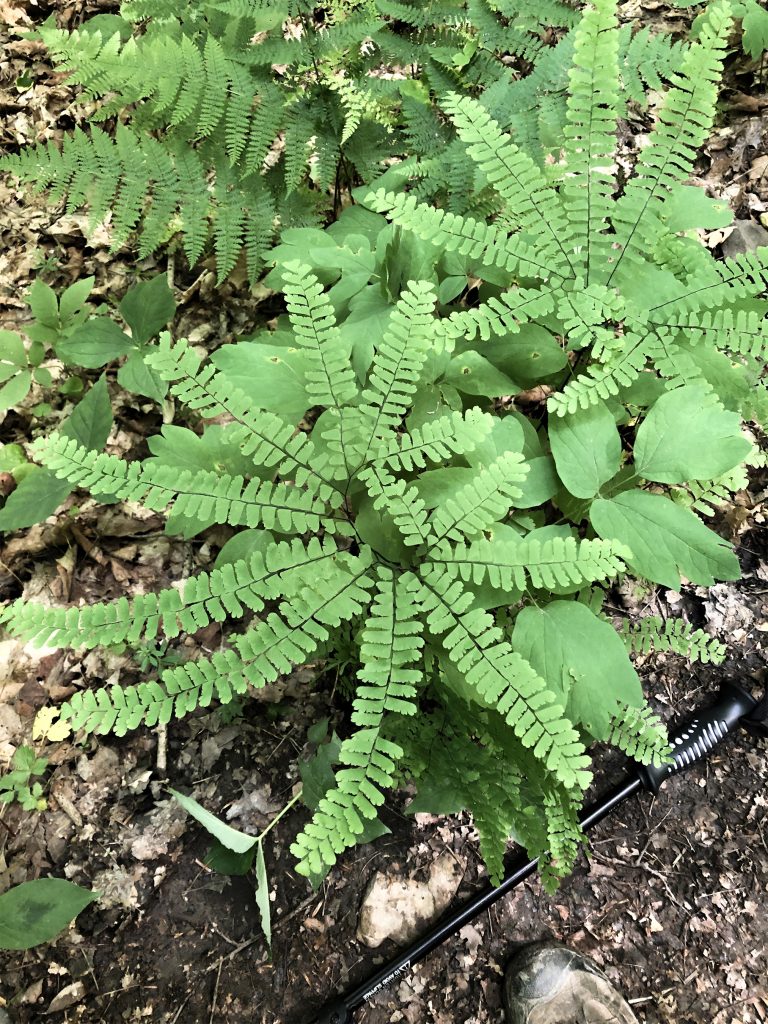
Ferns – Allegany State Park
Salamanca, NY
June 9, 2019Allegany State Park, Salamanca, NY June 9, 2019
Talia Yarbrough; Lemon HandReggie McCafferty; The crossing of the CualngeJared Dawson; MASS MOCA walls
State of the Art Gallery was founded by a group of photographers. In the very first year the gallery existed, the members held a juried photo show, inviting photographers from the greater Ithaca community to present their work with the opportunity to win cash prizes. Thirty-three years later, the annual photo show is upon us once again.
David Watkins has been a member of the Gallery since 2005. When he joined, there were only around 3 other members who were photographers, so he naturally fell into helping out with the photo show. At that time, everything was administered completely by mail. The back room of the Gallery, aka the Salon, was covered in tables stacked miles high with over 300 letters, containing contact information and fees paid. Framed photographs were propped up against every wall, and David would be joined by three or four other members to judge which pieces would be included in the show. Picking their way across the mazelike room, they sifted through copious amounts of images to finally emerge days later, beards long and hair matted, having decided upon a sensible 70-90 pictures to hang. Things are a lot easier nowadays.
Six or seven years ago, the Gallery made the decision to move the process of jurying shows to an online format. This period involved David receiving hundreds of photographs via email, compiling them onto a thumb drive, and bringing them over to gallery member Stan Bowman’s house, as he had the biggest screen at the time. The jury would discuss the images together, and vote pieces into the show. It involved a large amount of emailing on David’s end but saved a lot of trees and sheltered jury members from having to face the photographers whose works did not make it into the show while they picked up their rejected prints. This mostly online model worked well enough, but the process of jurying shows moved completely online in the nick of time.
In 2019, the president of SOAG, Susan Larkin, tasked David with distilling the photo show process into a numbered set of rules, in the event that he is hit by a bus and cannot run the proceedings anymore. Susan is ever the pragmatist. He was just finishing collating all the information that had become second nature to him when Eva Capobianco got involved. Eva runs the invitational show, and she was fed up with the time-consuming process as well. Putting their heads together, she and David researched the different ways galleries accept online submissions, and discovered that the best website to use was called EntryThingy. It has an impressive back-end operation with a plethora of different options in terms of how entries can be submitted and viewed. They adopted the use of the website in 2020, which proved to be a timely choice as the world soon made the startling shift to almost exclusively existing online.
The process is much less laborious now, and David only has to stand sentinel over his computer in the last forty-eight hours before entries are due. In his experience, 85% of artists, time and time again, wait until those last two days to submit their work. But the majority of the work is done by the website, and he and the members who jury the show are able to do so from the safe comfort of their own home. The website features a ranking tool, allowing jurors to vote on each piece on a scale of 1 to 5. David doesn’t let anyone choose a 3, as it’s too noncommittal.
Once the show is hung and ready to be viewed, an independent judge with no relationship to the jury or tie to the gallery, is brought in to assess the images. Faculty from Ithaca College, Cornell University, Rochester Institute of Technology, and other nearby schools and businesses have served in this position before. They are given the freedom to choose how the prize money is divided, and they award the winners on the opening night of the show.
This year, the photo show is happening in person once again. On the day of our interview, in late April of 2022, David didn’t have too much hands-on work he was dealing with leading up to the show. He monitored the gallery’s PayPal account and mailbox periodically to check for fees coming in, but other than that, his stress levels are far lower than they were in past years leading up to the opening. One facet he is looking forward to most keenly for this year’s show is the opportunity to see many local photographers, from Rochester to Binghamton, whom he’s become friends with. Throughout the years they’ve built up a large network, and spend as much time socializing as they do discussing their pieces. And after two years of relative isolation, it’s high time we socialize once again.
Bringing one of State of the Art Gallery’s longest-standing traditions back to its walls, the 33rd Annual Juried Photography Show runs from June 2nd to June 26th.
Carla Elizabeth DeMello;Mecynorrhina torquata;Sculpted paper and gouache;7;9;;180;Margy Nelson, “Tiny Predators (Jagged Ambush Bugs)”Diana Ozolins, “O.D. Von Engeln, Malloryville Preserve”
May has seeped into the streets of Ithaca once again. Tulips are in full bloom, the sweet aroma of flowering trees permeates the air, and the temperature is consistently above 50℉ (finally!). Inside the gallery, the art is reflective of this hopeful season with the new show “Wings, Petals, and Leaves”. Bright colors and extraordinary critters are explored in exquisite detail in this one of a kind trio show, on view from May 5-29th.
The digital artist and photographer of the group, Margy Nelson has been persuading Carla Elizabeth DeMello to join her as a guest in the gallery for years. The two women are a part of the Guild of Natural Science Illustrators, and have crossed paths many times through different art openings and Guild events. They joined Diana Ozolins for this springtime show and found an effortless theme amongst their collective subject of choice- nature.
Margy, a former research scientist, has been studying insects for much of her adult life. A few years ago, she was photographing the goldenrod plants growing alongside her driveway when she realized how many insects were living on them. In the words of her husband, she became obsessed with the goldenrod, taking more and more pictures, delving further and further into the incredible and complex world that buzzes around this essential plant. She would take pictures of the creatures she saw, then use different online guide websites and Ithaca colleagues and friends to help identify the insects. A distinct challenge in creating this series was allowing her artistic influences to take over, and turning off the scientific side of her brain that requires every image to be scienfically accurate. The graphic designs currently on view are the result of a four year long goldenrod fueled exploration.
Carla’s chosen medium has always been sculpture. Previously a potter, she transitioned to working with paper when she no longer had the specialized equipment to work with clay. She has found paper to be infinitely shapeable and wonderful to work with, and the possibilities for color and texture are limitless. She has been honing this art form for the last 30+ years, and this is the biggest show she’s done yet. Many pieces are from her private collection, pieces she has sold or gifted and borrowed to display, or made specifically for the show. Like Margy, Carla is interested in the little creatures that are often unnoticed by passers by. Birds, fish, insects, and most recently snails are her primary subjects.
Diana, on the other hand, feels that she started observing nature later on in life. She was 18 when she remembers it first piquing her interest, though Margy reminds her of her childhood in New York City observing the ants on the fire escape, cockroaches on the bannister (though luckily not inside her apartment), and flower pot gardens on the roof of her building. Even in a city not particularly known for its wildlife, Diana still found herself connected to nature. An oil painter, she sets up her easel outdoors and paints the beautiful landscapes and sunlight she finds. Often with the aid of a bug net and sunblock while outdoors, she adds additional detail and finishing touches in her studio.
Describing the way she paints, Diana explains how she works in multiple layers, sometimes scraping back down to the shadows of the first rough sketch before finally getting things to look just how she sees them in her mind. Carla and Margy relate to these parts of Diana’s process, as they both work in layers as well. Often, Carla will decide that a sculptural element isn’t quite working, and she’ll find herself cutting and recutting paper to create a multitude of complex designs that coalesce into one seamless piece. Margy loves the ease of working in layers on a computer, allowing her to save different versions of images and come back to them at later times. She has a giant folder of Adobe Illustrator files from her goldenrod series, as she saves every step of her thought process.
Upon hanging the show, Diana suggested that the art be hung all together, as opposed to separating it by artist. This creates an effortless flow through the Gallery. The different mediums complement each other gracefully, and are married by both color and theme. There is an almost accidental Ithaca motif moving throughout the collection. Diana paints landscapes of the surrounding Ithaca area, Margy’s insects are local to Ithaca goldenrod, and some of Carla’s creatures, such as the ladybug and great blue heron, are native to the area as well. Paired with in depth descriptions, viewers can learn more about the mimicry in the insect community, the history of land use in Ithaca, and literary allusions to the connection between humans and nature.
Carla’s views “Wings, Petals, and Leaves” as an invitation to come closer and look at nature with a different eye. Notice what is easily overlooked, and think about your place in the world. Diana wants people to know that there are really beautiful settings all around us, and many things we can do as individuals to give back to the land that gives so much to us. In Ithaca, we are fortunate to have many land trusts and organizations, such as the Cayuga Bird Club, that work to keep these places preserved. It is also thanks to the generosity of people such as Robert J. Treman and Roy H. Park that many of our gorges are protected, and this generosity is ever present in our community today. Margy hopes visitors will leave this show and look more closely at what’s around them, realizing how beautiful and complex the natural world really is. Diana concludes by sharing her vision of people going out with a lighter heart than they came in with. After talking with these three extraordinary women, I feel immensely lighter myself. And ready for a hike.