Category Archives: Uncategorized

Rorschach Gone Wild

Discourse upon “RORSCHACH GONE WILD”

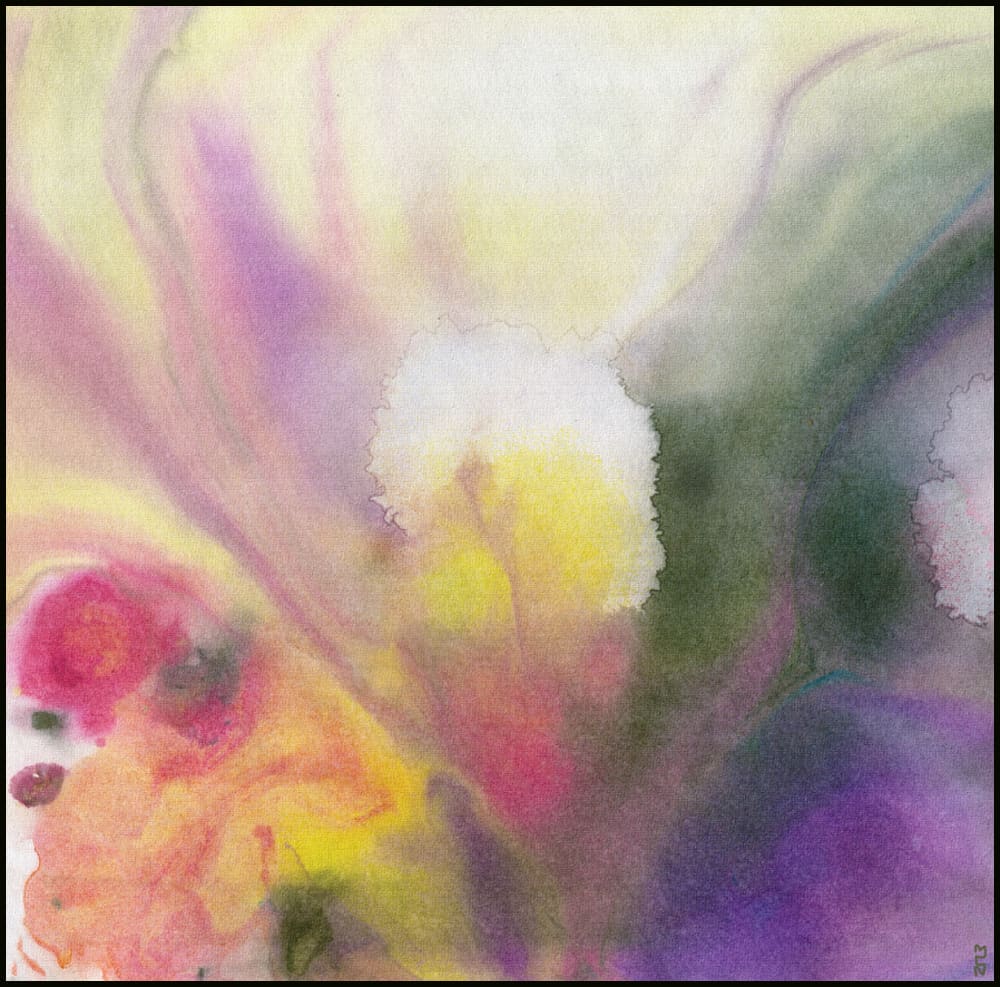
This exemplifies an approach to creating a new painting which I have used in various ways for my abstract watercolors.
I lay down a design using a variety of colors and means of modification (salt sprinkled onto the wet surface; plain water added to a section of paint a bit before it dries, plastic wrap crinkled over wet paint…)
Then I add form to it in some way, e.g. highlighting areas with brush lines. An earlier post, “Abstract Flow”, uses the same approach, with glazes of darker paint highlighting shapes I saw in the first state.

In this case, I wanted to paint out parts of my starting design. For this piece, I scanned the original watercolor and went to Photoshop for further manipulation. That way, I could experiment with several approaches without losing the original. I experimented with blacking out a few parts of the painting until I liked the effect, and added a black background; copied and flipped the design to face the other way and placed the two versions together to form a different effect; and outlined all the colored portions. I kind of liked it. I showed it to my husband (a neurobiologist), who said, “Oh! A section of nerve cord!”…
But he also saw two couples kissing (the “Trump Kissers” — can you find them?). Meanwhile I saw two conjoined turkey carcasses, and a Rorschach butterfly.
I hope someone who sees this will tell me what they see here!

the original (“Shining”): 1. indicates some of the places where kosher salt was sprinkled on the still-wet area and allowed to dry, then brushed off. 2. indicates two areas where I dripped plain water onto a partly-dry area of paint to create flow patterns.
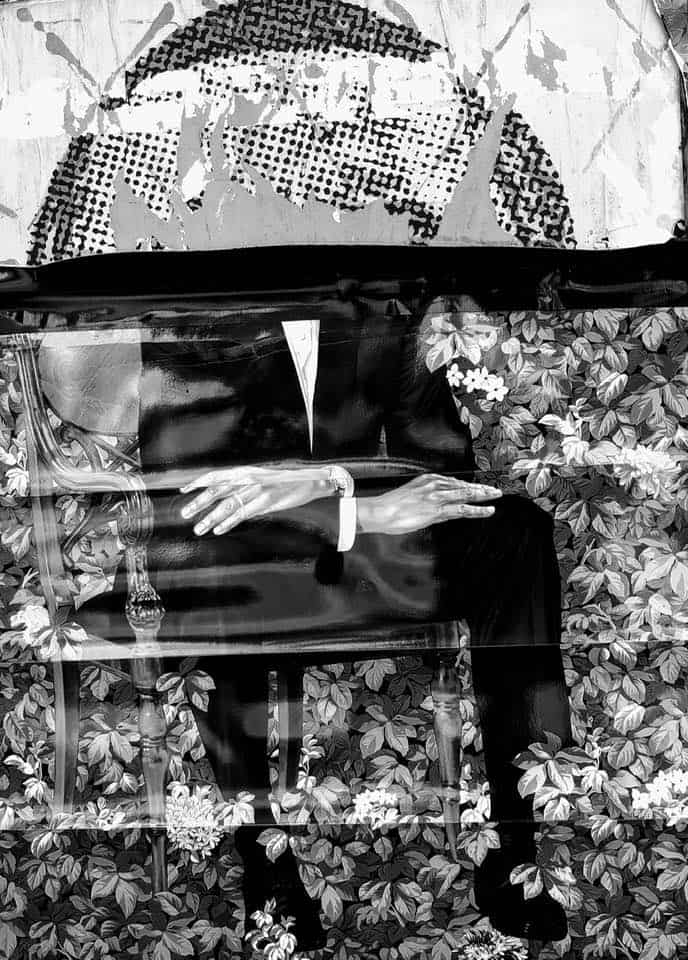
“Monotone, Duotone,Tritone

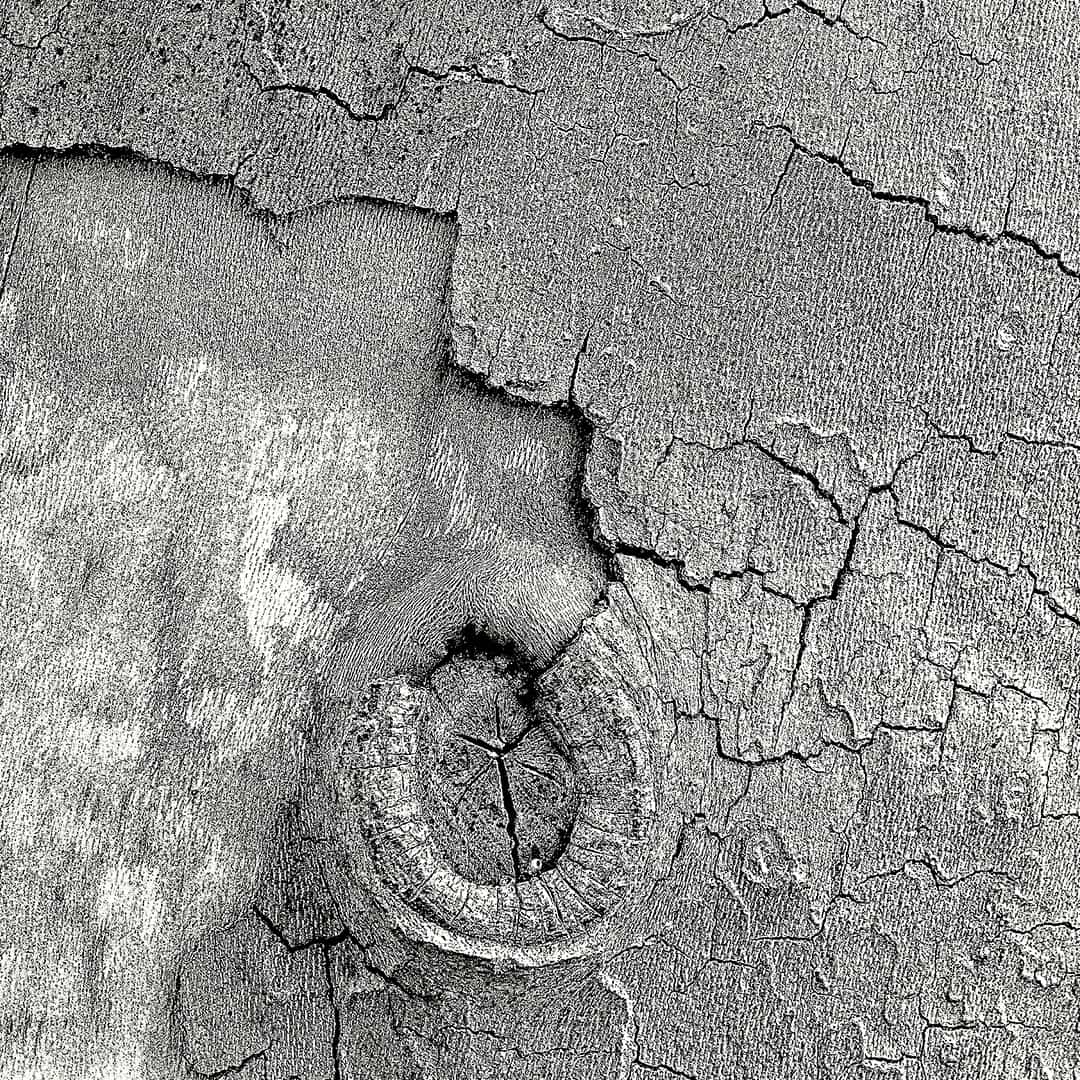
The images in this series are from a new book being published in late November. They represent a variety of images that I’ve photographed over the years but avoided using or showing. While working on a previous book and slide presentation for a 2020 July show with Jan Kather, I ran across a series of images that prompted new processing. While mostly working in color with my botanical images, converting these to a form of black and white, or monochrome images created the portfolio for a new book: “Monotone, Duotone, Tritone”. Clearly they do not fit my usual botanical subject matter-rather, they represent my life long fascination with graphic design.

Revolution/Revelation

Revolution/Revelation

Metal Print 16i”x16″ NFS

Tomorrow is the big day – will we have new leadership in America? Many in the nation are on edge, worried about a potential difficulty if there is a transition of power. I think of my recent installation Revolution/Revelation that included this digital collage. A palimpsest of 18th Century French Revolutionary painter Jacques Louis David’s famous painting Death of Marat lies beneath the “leaden bed covers” of one of Marat’s adversaries, Madame Roland, found in an Anselm Kiefer installation at MASS MOCA. Anyone connected with the aristocracy (a Girondin) was added to Marat’s hit list and sent to the guillotine for beheading. Roland and other Girondins were beheaded for proposing a constitutional monarchy that would allow for a peaceful transition of power.His assassin, Charlotte Corday, was beheaded for her treasonous act of stabbing him in his bath.

The image of the three stems protruding from the blankets of lead in this photo comes from Kiefer’s ideas about a sunflower. The dead sunflower holds many seeds, that when planted, sprout new life. Let us hope that we can come together peacefully as Americans, and sprout new life, no matter the outcome of the election.

More Geology

Deep within the earth’s crust and upper mantle, fissures open up. Minerals dissolved in superheated water and gasses are deposited in the cavities. If this process is slow enough, the different minerals will solidify into distinct bands.

Friends Until the End

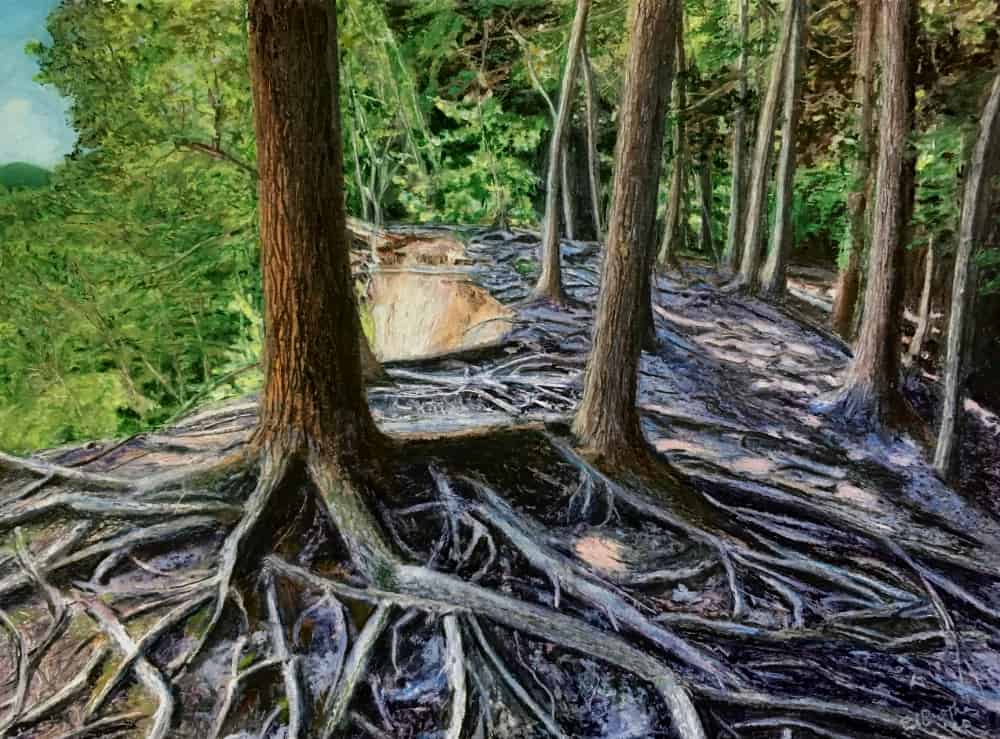
I had a difficult time deciding on a title for this new painting. Some of you might recognize the location as a Fall Creek cliff near Varna. I’ve walked past this spot many times, but the lighting on one particular day highlighted the complex root pattern in a way I knew I had to paint. Trees are now thought to communicate (“The Hidden Lives of Trees, What they feel, How They Communicate” by Peter Wohlleben) via chemicals, hormones, and electrical signals produced by fine root structures (mycorrhizal network) and associated fungi. It’s a form of social network on the “wood-wide web.” If you’d like to learn more, read the book or a shorter descriptive article in Smithsonian Magazine (https://www.smithsonianmag.com/science-nature/the-whispering-trees-180968084/). Of course, the active elements in this web are subterranean, but the exposed roots here are intriguing as an artistic element. I also found the drama of the scene compelling. These trees are on edge of a cliff, and some are already beginning their descent to the creek bed. The life of these trees are already beginning the final lean over the precipice, eventually to be followed by a swift tumble to the waters below. Roots are a metaphor for history and stability, but this scene illustrates that a process is already in progress which cannot be resisted indefinitely.

Blueprint for Pears

Blueprint for Pears began as a pencil sketch (second image) that was done during a recent sketch-and-meet zoom meeting for the local illustrators’ chapter of GNSI, Guild of Natural Science Illustrators-Fingerlakes chapter. I began coloring the pears (as I did for a previous piece in this Salon, “Two Eggs”). But for some reason, before I started on the second pear, the idea popped into my head of leaving it just partly colored, and from there the full-blown concept of a blueprint emerged — no idea why but that is part of the fun of creation! Producing that was great fun, though also a bit tedious when I began removing the grid lines that covered the original image… why did I DO it that way???… and it was necessary to look up some images of blueprints to get things right. But this finished piece does make me feel happy when I look at it.

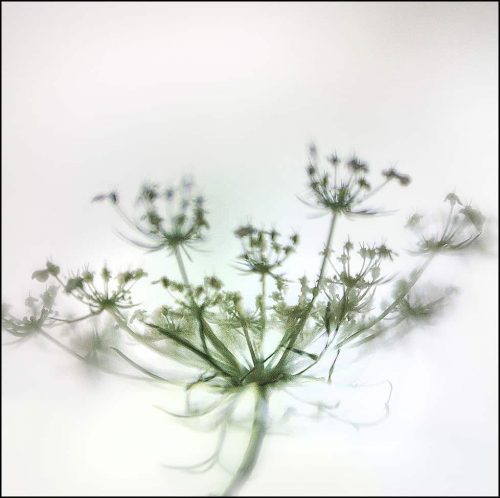
“Daucus carota”

For the past 20 years, my fine art photography has been predominately botanicals or landscapes in color.   But, while searching for images for an earlier book, “In The Style Of”, I started to run across random, more abstract photos that I had processed in a monochromatic, abstract style. Some of those images became new favorites and will appear in a new book: ” Monotone, Duotone, Tritone” to be published in late October, 2020.

Many of those images have never seen the light of day but now seem worthy of additional attention and processing by pushing the limits of the abstract nature of the original color image, converting it to black and white, removing content and/or adding texture.

Textures in Stitch and Stroke

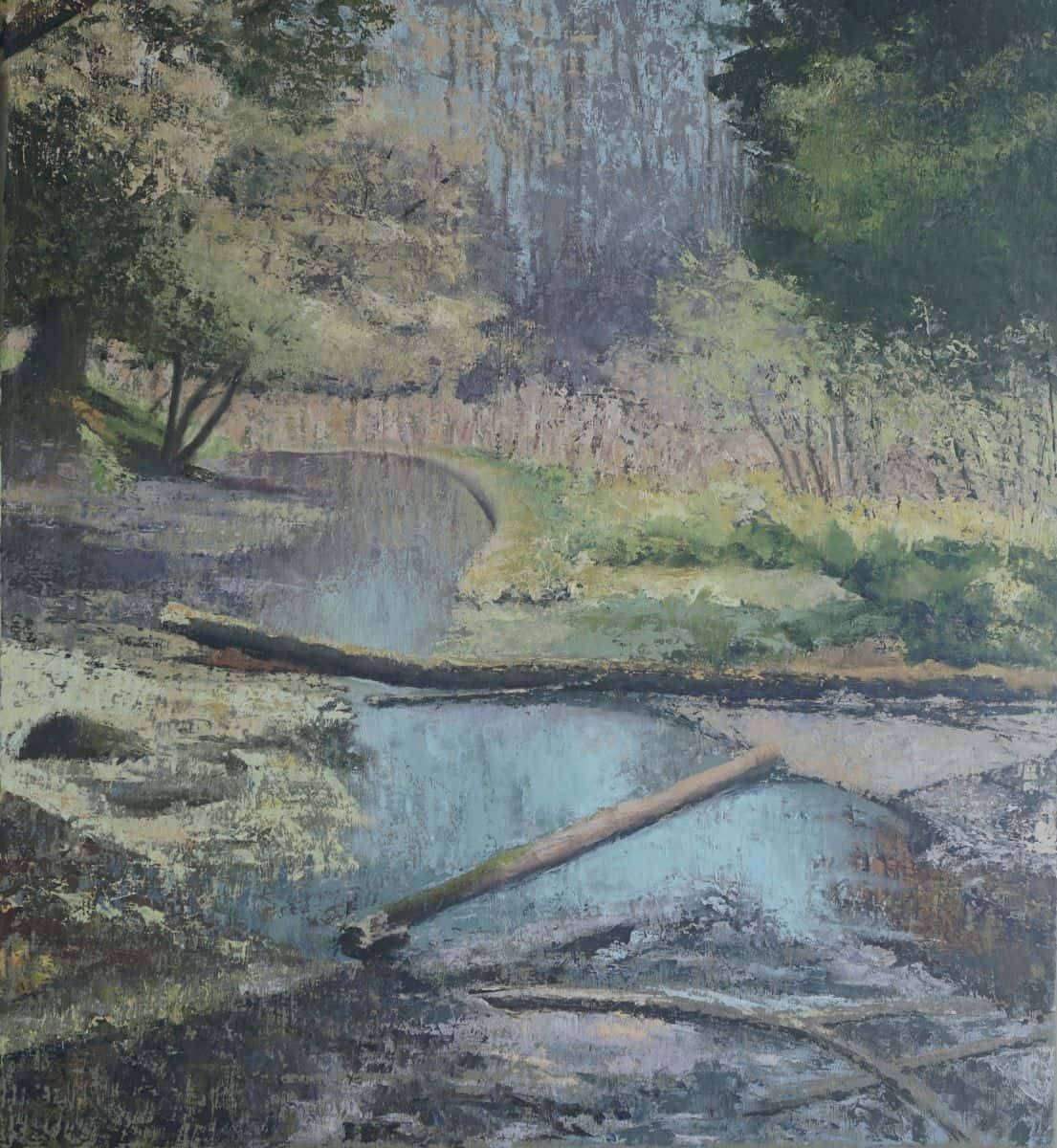
O.D. Von Engeln nature preserve in Malloryville, N.Y. has a unique combination of natural land forms that result in a variety of different habitats both wet and dry. I captured this image on one of those heartbreakingly brilliant early spring mornings. This is one of the paintings that will be in a show at the State of the Art Gallery during October that I am sharing with my fellow artist, Saundra Goodman, called Textures in Stitch and Stroke. Saundra’s medium is crochet, hence the stitch in the title. I hope this little preview inspires you to come down to the gallery to see the rest. The show will run October 1 – November 1, 2020.

New Work, 9/20/2020

“Unfettered Flow” was created by floating sumi inks on a pan of still water, and laying paper over the water surface to take up the inks. This is a delicate way of creating a monoprint, which is a print with a single unique version. Thanks to Photoshop, though, I was able to go further and make a monotype, basically a monoprint which has been modified after it is created so that each version is slightly different. (This isn’t quite an accurate definition in the traditional sense of these two terms, but in our modern digital world it is the closest I can come to a definition… I hope someone reading this post will add to this if they feel so moved!) I scanned the original print and modified it in Photoshop, enhancing some parts, “dehancing” others, and adding a bit of texture, until I had what is posted here. For me, Photoshop is a wonderful tool for expressing the “deep structure” of what I start with.

“Reflected Tree” is just a part of the years-long journaling I have maintained of images of Beebe Lake near Cornell: we live just a few steps away and there is so much to see there as the seasons and weather change. This was taken early this spring before all the foliage greened up, and geese with their goslings were all over the lake (the goose was cropped out in favor of emphasizing the verticality of the image). Other than that, no liberties were taken with this photo!