Author Archives: Margy Nelson

Member discussion of Generative AI

Earlier this summer, eight members of the gallery met to share their thoughts about art created using generative AI. Below is a summary of our discussion. We hope to start a discussion on the blog about this issue.

The image above was created in ~ 5 minutes by Margy using the prompt, “Teddy bears hugging on a beach.” Do note the disturbing placement of their legs!

HARRY
I see generative AI as a new tool. Most of the images currently being created by AI are rather silly but eventually someone will create great art with it. 
 
I feel like we’re at an 1839 moment—the year photography was invented. At the time, painters were not happy about it, but it allowed painting to move away from realism into impressionism and abstraction. Eventually photography became accepted as art. Similarly, AI could nudge us in new directions. Like any art, successful AI will depend on the ideas behind the work and the context it is shown in.
 
I don’t think AI is a threat to SOAG at this time. We have strong filters in place. New members are thoroughly vetted. Work coming into the juried shows is evaluated by numerous members before it is accepted. SOAG is not at risk of being overwhelmed by AI. I would be in favor of allowing AI submissions to juried shows as long as it is identified as AI generated work. Whether it gets accepted is up to the members jurying the shows.
 
SOAG could use AI to generate discussion. Maybe we could invite someone using AI to the 2025 Invitational Show.

MARGY suggested we do an AI themed member show in the Salon—that would be fun.
 
 
DANIEL:
First, since there is a lot of misconceptions, we should agree on what AI is. Many think that if a computer is involved in the creation of an image then that is AI. I propose that when we talk about AI we are referring to generative AI (unless otherwise specified). Generative AI art is an image that is entirely machine created, based on text prompts. It is based on billions of images, most scraped from the internet. These are digested by machine learning algorithms and the output is an image that has no human creative participation.

We all  expected there to be many AI submission to the gallery from outside artists but as it is now  there is no reason members cannot submit AI for exhibit.

Do our current standard for membership requiring creativity and imagination somehow eliminate AI? Do we need to review our standards to include or deny the use of AI?

ETHEL was mainly opposed to AI and questioned how we could attribute authorship to an individual who shows AI when it is an amalgam of ideas from other people and sources? 

MARGY Are there copyright issue we need to explore? 

Daniel was concerned about the eliminations of creative jobs, and stress on our electric grid with so much AI coming. 
Daniel is not thrilled about the AI “revolution” but feels it will be unstoppable and will be a big part of art and design in the near future. Margy believes that is an overstatement: that there will always be those who take pleasure in the physical act of creating.

Should we have a separate category for AI in our shows?

Everyone felt AI art should have explicit labeling.

Ed Harry and Vince felt something important is lost in the “craft” of making art using  AI. 

Harry and Vince said we should just let AI be submitted and then to judge it on the current standards of the gallery. If it is good art by our standards.  

Are our current standards for membership and showing  enough to cover AI? 
VINCE suggested then that we have a process to review , as a gallery — as– members- our feelings, ideas and definitions or what good art is and what our standards are.  All agreed this would not be easy and consensus would be difficulty.  Vince suggested something worthwhile might come of the process especially since we will all not agree but will express our  differences. 
Are our current standard for membership and showing  enough to cover AI?

We hope other members will weigh in with their thoughts on the issue! 

Drawing from a dream

A few days before Christmas I awoke from a vivid dream about creating a painting, something vaguely reminiscent of early 20th century French painters (Les Fauves, maybe?) I felt frustrated because just before I woke up I was trying to find the right color for part of the woman’s face, but I woke up before I could do that. The image/idea stuck in my mind over the holidays, and a few days ago I sat down with some colored pencils to attempt a reproduction of the image from my dream. Now the actual drawing and the dream image are entirely scrambled in my mind and I no longer know how much they relate to each other, but it was satisfying to try. I tried to introduce as much pattern as I could; that felt right. For the floor, which was last to be filled in, I cut out paper pieces the same shape as the foreground floor and tried several different designs until I found one that felt right.

Gaston Mouse Returns

Gaston, our gallery mouse, has agreed to show some of his art, though he feels a bit shy about it. He has taken on one of his favorite subjects (cheese). He greatly admires the cubist approach but as you can see he is torn between the geometric dissection of Cubism, and the eeriness of Surrealism.

The Gallery Mouse

Today while putting the finishing touches on our wonderful February show, “Awakenings”, Jay and Patty encountered a mouse in the gallery. It went to ground in the supply closet, but has since sent me a message: “Please, please, I am an artist too! Please let me join the gallery, you are a wonderful group and I so admire your work! I can clean out small corners and chase away spiders for you!”

He awaits our decision. Meanwhile, he may post some of his own art here, so WATCH THIS BLOG!

Five Pieces in the Shape of a Pear

Five Pieces in the Shape of a Pear…
This was an exploration through levels of representation / modes of seeing.
It began with a photograph in which I captured a pear in a glow of late morning sunlight on my kitchen counter (Pear I). Using that as my model, I painted a realistic watercolor of that photographic image (Pear II). I showed my painting to a friend who didn’t quite like it (why, I can’t recall!) so thought I’d try again, but I found that I had “used up” that mental image of the pear… its energy had gone into the first painting and I couldn’t recapture it.
So instead, I distilled the pear, so to speak, and created a more simplified image (Pear III). Intrigued by that process, I repeated it (Pear IV) – this time propping the first painting on the counter, and stepping away to the far end of the kitchen, sans glasses, (a distance of nearly 20 feet) to make another watercolor sketch. Finally, I took another step away, from realism into a digital abstraction of the pear on the counter (Pear V), using Pear IV as inspiration.

I found it very interesting that each concept of the pear on the counter had only so much energy to contribute, that once it had flowed from mind through hand to paper, I had used it up, and no longer could – or wanted to – recapture it: a little like rubbing a wand on a cat’s back and then releasing the spark of energy that builds up, by grounding the wand. This is something I have noticed a number of times over the years (in my art, not so much with my cat…); I wonder if it reflects something about the creative process… or if it’s just me!

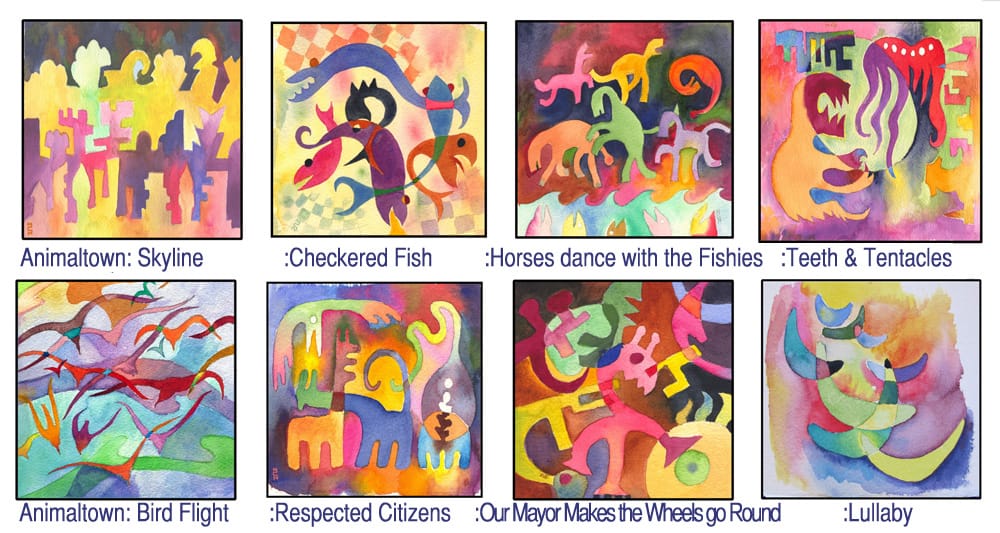
Animaltown, the series

A few year ago, wanting to play with overlays of contrasting and complementary watercolors, I pencilled a doodle of whimsical shapes, then filled in all the spaces thus created. I used both blends and contrasts and enjoyed the exercise, to the point that I ended up with a whole series of these little paintings.
These became the “Animaltown” series in my mind, because most of them involved doodled animal shapes. Naming each became a very entertaining part of the process, as I began imagining how each piece fit into the world of AnimalTown.

These eight pieces are now on view at State of the Art Gallery, as part of our first show of 2022: “The More You Look the More You See”, with work by ten members of the gallery. The show runs through the month of January.

Unbound

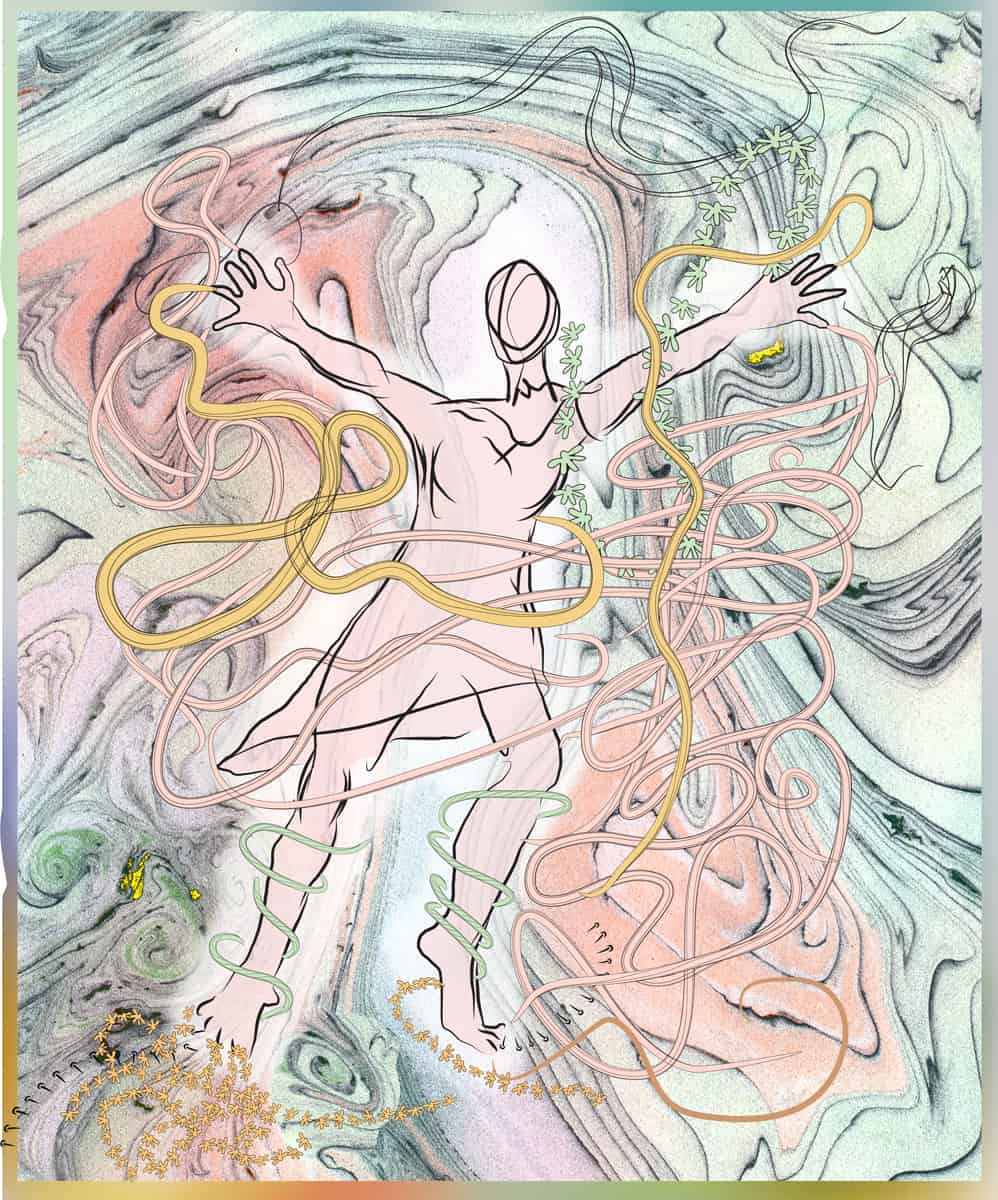
This sketch arose from a chat with an artist friend about what it feels like to be creative. I came home and drew the image that arose from our conversation, though she said the sketch didn’t reflect how she visualized it at all! To me, it feels like many lines of force swirling around me, waiting to be captured and woven into a coherent image. I hereby challenge her to add her own visualization! 🙂

Cookie Sketch

Just a sketch, drawn in pencil, massaged in Adobe Illustrator — explained by the text at the top — but for those of you who celebrate Christmas, this is for all of you… Merry Christmas and a Happier New Year!!!

And if anyone wants the recipes for these, let me know! The Kremscnitten came from a friend of my Jewish Grandmother in Cincinnati, to my grandmother, to my mother, to me… they are a version of an Eastern European confection that I have never seen made this way anywhere else. The hamburger cookies came from one of Ron’s grad students, years ago. So ess, meyn kinder!

Rorschach Gone Wild

Discourse upon “RORSCHACH GONE WILD”

This exemplifies an approach to creating a new painting which I have used in various ways for my abstract watercolors.
I lay down a design using a variety of colors and means of modification (salt sprinkled onto the wet surface; plain water added to a section of paint a bit before it dries, plastic wrap crinkled over wet paint…)
Then I add form to it in some way, e.g. highlighting areas with brush lines. An earlier post, “Abstract Flow”, uses the same approach, with glazes of darker paint highlighting shapes I saw in the first state.

In this case, I wanted to paint out parts of my starting design. For this piece, I scanned the original watercolor and went to Photoshop for further manipulation. That way, I could experiment with several approaches without losing the original. I experimented with blacking out a few parts of the painting until I liked the effect, and added a black background; copied and flipped the design to face the other way and placed the two versions together to form a different effect; and outlined all the colored portions. I kind of liked it. I showed it to my husband (a neurobiologist), who said, “Oh! A section of nerve cord!”…
But he also saw two couples kissing (the “Trump Kissers” — can you find them?). Meanwhile I saw two conjoined turkey carcasses, and a Rorschach butterfly.
I hope someone who sees this will tell me what they see here!

the original (“Shining”): 1. indicates some of the places where kosher salt was sprinkled on the still-wet area and allowed to dry, then brushed off. 2. indicates two areas where I dripped plain water onto a partly-dry area of paint to create flow patterns.

Blueprint for Pears

Blueprint for Pears began as a pencil sketch (second image) that was done during a recent sketch-and-meet zoom meeting for the local illustrators’ chapter of GNSI, Guild of Natural Science Illustrators-Fingerlakes chapter. I began coloring the pears (as I did for a previous piece in this Salon, “Two Eggs”). But for some reason, before I started on the second pear, the idea popped into my head of leaving it just partly colored, and from there the full-blown concept of a blueprint emerged — no idea why but that is part of the fun of creation! Producing that was great fun, though also a bit tedious when I began removing the grid lines that covered the original image… why did I DO it that way???… and it was necessary to look up some images of blueprints to get things right. But this finished piece does make me feel happy when I look at it.