Category Archives: Uncategorized

Book 2, Map 17

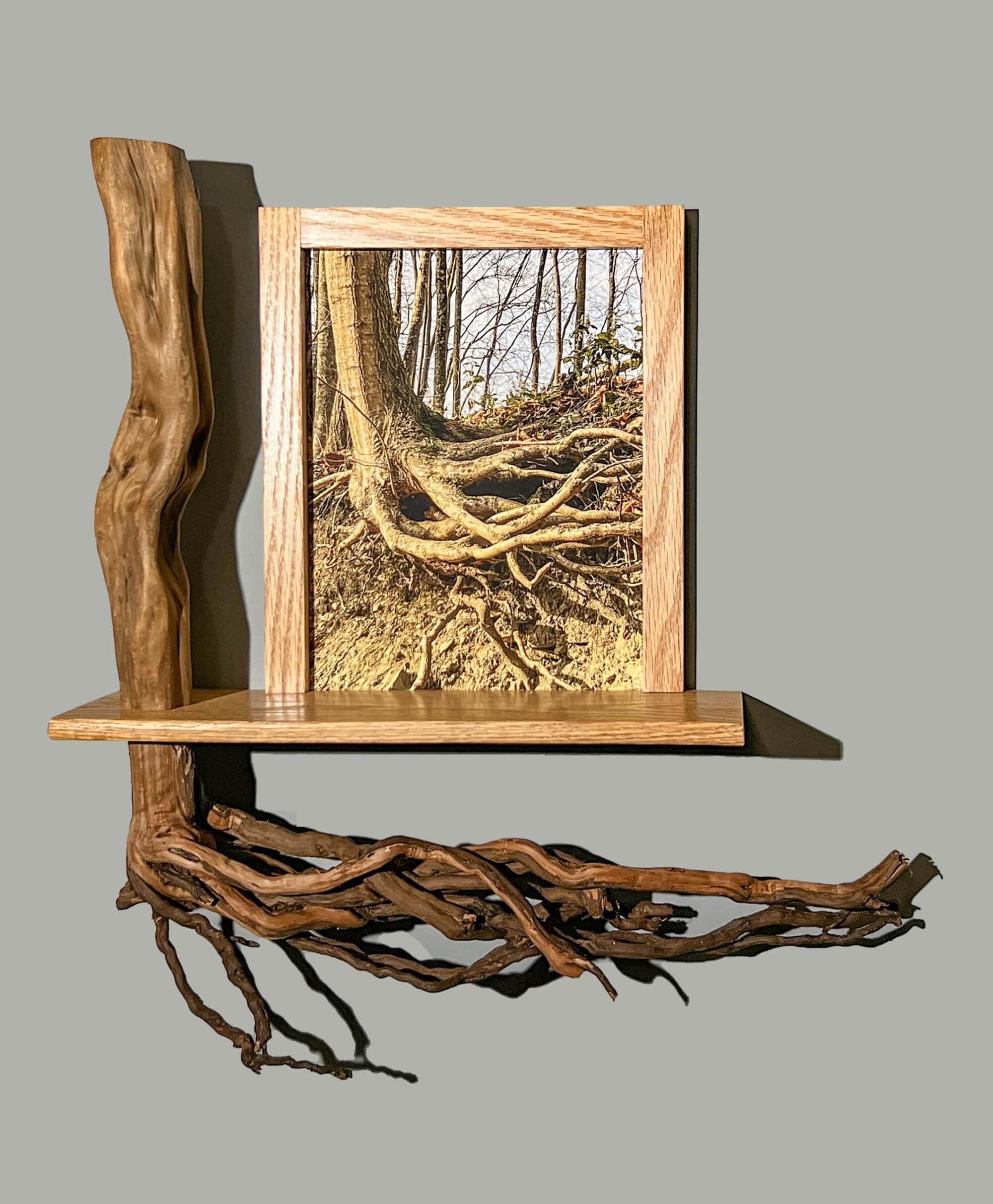
Tree Roots – 2024, photo, found and reused wood, 22 x 20 x 5 inches

In July of 2017, I planned a hike in Danby. After leaving my car at Eastman Hill Road, Elizabeth drove me to Durfee Hill – a very steep, very rocky, seasonal road. I start climbing up, expecting to turn off onto what the map described as a private, woods road. It was not quite one mile to the turn. I climb and climb but I don’t see any sign for the turn. Eventually I decide I must have missed it. I head back down the hill and this time I see an intersection, but it is marked on both sides “no trespassing”. So I keep going down the hill, but I am sure I have gone too far again. I go back to “no trespassing” signs and I think this MUST be it. Maybe the signs just mean I must stay on the road but not stray onto the property on either side. I walk in and very quickly see the white blazes that indicate this is indeed the Finger Lakes Trail.

The rocky climb on Durfee Hill Road gives way to a lovely stroll through the woods. I continue a mile and a half to the next intersection at Heisey Road. But my map shows the trail turning left here. Instead, I see brand new white blazes telling me to continue straight into the woods. I follow the trail another half mile and I am back at my car. Back home, I go on the FLT website and look at Map 17. They had JUST published a new version of the map. That’s when I learned the lesson that would have saved me many miles of hiking and hours of confusion. Before starting any hike on the FLT, one should check to be sure one has the latest version of the map!

In 2017, I did not have the slightest inkling about creating a series of sculptures about the trail. So in 2023, when I realized that I had very few photos from Map 17, I asked my friend, Susan Larkin, to hike part of that map with me again. We set out together on a crisp, sunny November morning. I thought this train bridge would be the answer. Then we continued up the hill toward Lick Brook Preserve. I captured some images of a tree with its roots exposed by erosion. One of those photos inspired the sculpture shown on page 32.

Toward the end of the hike, Susan and I sat for a while and discussed our plans for the exhibit we would have together in October of 2025. For her recent work, she has collected photographic portraits and interviews of people in her community, looking for connections and common ground in these difficult times of polarization in our country. The resulting books are both beautiful and compelling. I had mentioned to Susan my desire to create a book of my own based on my hiking adventures. Now, as we sat on a bench in the woods, Susan encouraged me to join her in a class focused on creating just such a book. I am so glad that I took her advice.

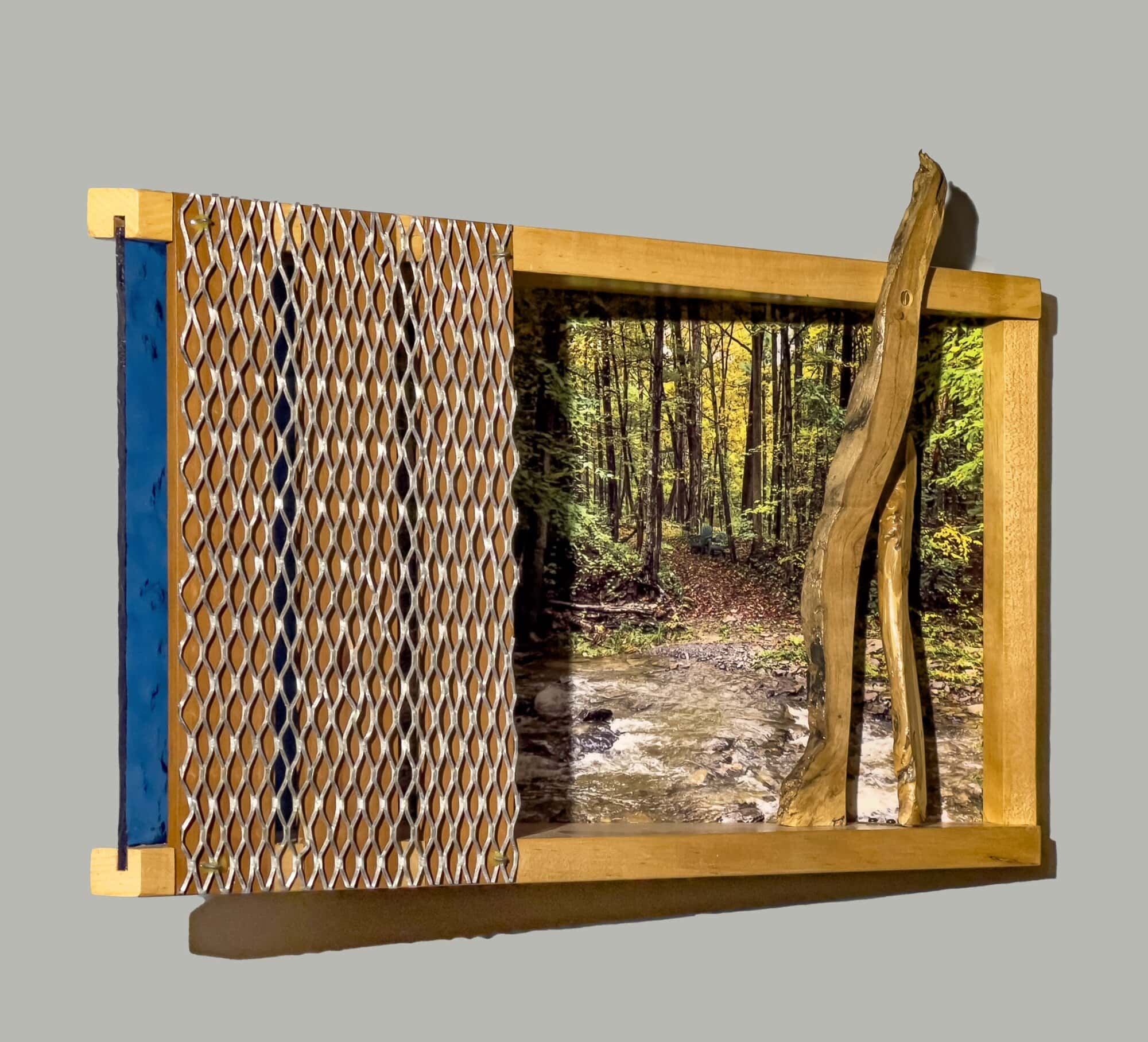
Stream Crossings II – 2020, photo, found and reused wood, acrylic sheet & wire lath

Book 2, Map 12

Book 2, Map 12, pgs 14-15
Book 2, Map 12, pages 14-15

I met Jacqui Wensich in 2018, the year I signed up for the County Hike series for the first time. Jacqui is the volunteer End-to-End Coordinator. She offers hikers assistance when they are working on completing the FLT. Jacqui maintains a list of trail spotters who will meet you at one end of your planned hike for the day and drive you to your beginning point so you can then hike back to your car. She keeps a detailed spreadsheet of the whole trail which hikers can use to log their miles and track how close they are to completion. And she maintains a list of everyone who has completed the trail and sends us our certificate, nametag, and patch when we finish.

I wrote an e-mail to Jacqui after one of the longer hikes in Delaware County. That day had been rainy and much of the twelve mile hike was through standing water. I told Jacqui that I did not think I would sign up for the county hike series again the following year. The hikes were just too long for me. At some point, it stopped being fun and just felt like a forced march. She agreed, especially when the trails involved a lot of hills.


After we finished the last Delaware County hike that summer, Jacqui and I decide to log some miles together on the maps between her home near Rochester and mine in Ithaca. We covered the 20+ miles on Map 12 together that September and October, enjoying the crisp autumn air and brilliant colors. It was wonderful to have found a partner with a compatible hiking pace and who agreed that seven or eight miles in one day is challenging enough to be satisfying yet still feel like fun.

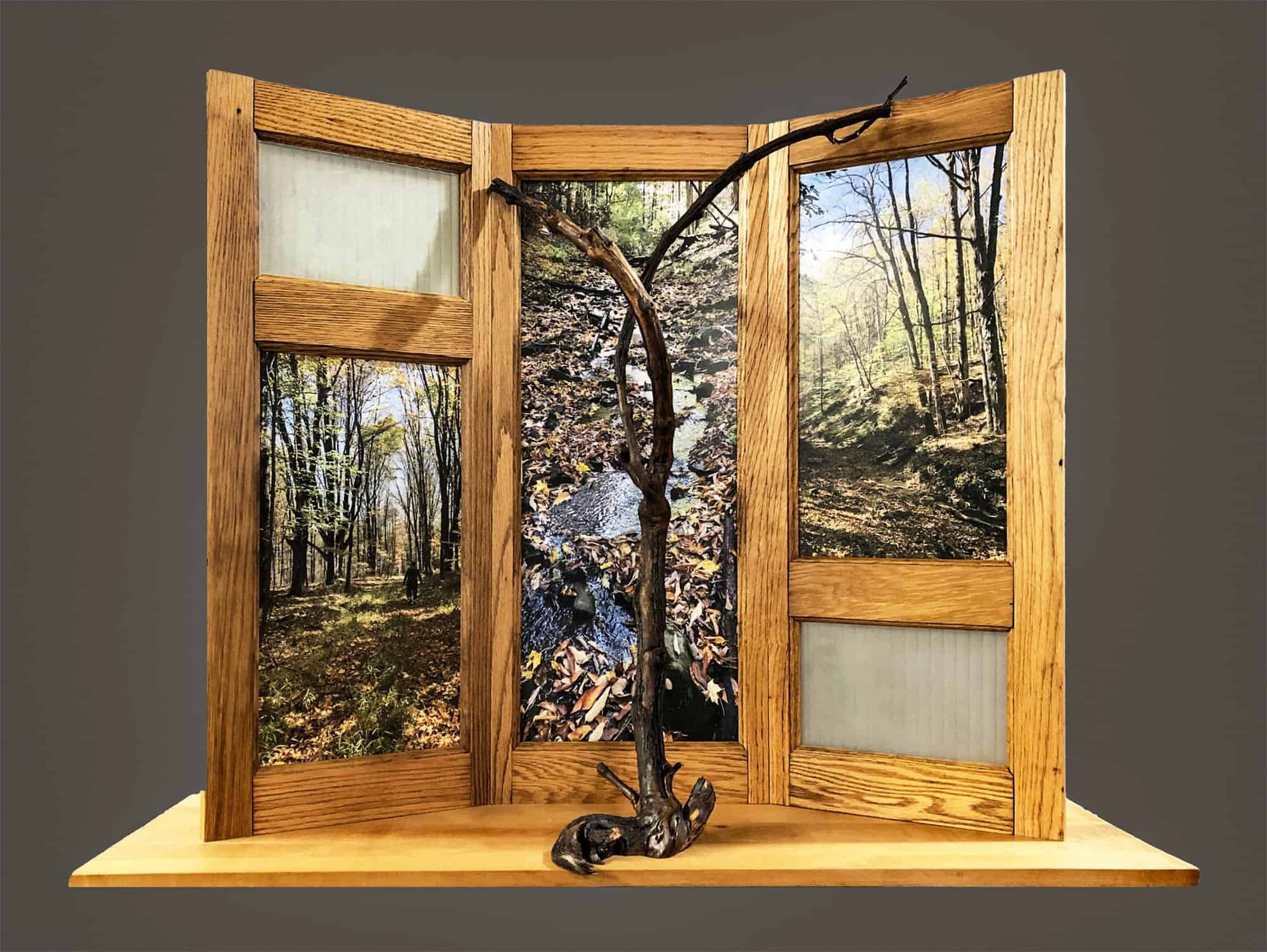
October Stream and Trees – 2022, photos with reused wood and glass, 29 x 37 x 11.5 inches

A Few Miles at a Time, Book 1, Map 09

October Stream and Trees – 2022, photos with reused wood and glass, 29 x 37 x 11.5 inches

Over the course of 584 miles of trail, you cross many roads. Some are seasonal, dirt or gravel roads in the woods. Many go through towns and villages. There are parts that follow along railroad tracks and there are a few small tunnels. But I think the most unique crossing is on Map 09, at Kanakadea County Park in Hornell. Here, the trail goes UNDER the four lane Interstate Highway 86. Robert and I were hiking from west to east and, after hiking up and then back down a small hill, I see a tunnel made of corrugated steel. It looks like a huge culvert pipe, about 4 foot wide and seven or eight foot tall. (Dave Newman later informed me that the tunnel was installed when I-86 was built in order to maintain public access to the part of the park north of the expressway.)


I watch as Robert disappears into the darkness. There’s shallow water on the floor of the tunnel, which leads me to worry about flash flooding, even though it is a perfectly sunny autumn day. I enter behind him and turn around to snap a photo looking back into the sunlight. Then, walking in deeper, I snap one more photo. It is now op-art: a psychedelic, almost black and white image. I can barely make out Robert’s silhouette way off in the distance, backed by bright white sunlight. I follow him in, trusting that I will not be swallowed up into some rift in the space-time continuum.

Crossing the Tracks – 2023, photos on metal, reused wood, 12 x 20 x 4 inches

A Few Miles at a Time – Book I, Map 04

In the summer and fall of 2022, I hiked a lot of miles in these western counties. To save gas and miles driving out there from Ithaca, I planned two consecutive days of hiking and stayed overnight in a motel. Robert was my frequent hiking buddy on these trips. But after planning two days of hiking in September, Robert could only make it on the second day. I wanted to cover almost seven miles on the first day, about half in the woods on Map 5 and the rest was road walk on Map 4. I reached out to hikers on the Finger Lakes Trail list-serve, but no one was available. However, Joyce Ermer offered to be my car spotter. She could meet me at one end and drive me over to the starting point so I could hike back to my car, alone.


The important part of this story is that my wife, Elizabeth, REALLY doesn’t like it when I hike alone. She worries about me. She is a worrier in general. To try to ease her fears, I showed her on the map how this part in the woods was never very far from the road. There happened to be no hills to climb, so it was unlikely that I would fall. And then the rest would be easy road walk. After much cajoling and many promises that I would be exceedingly careful, she reluctantly gave the OK.


When I arrived at the meeting place, Joyce was there and, to my surprise, she was putting on her hiking boots! She said, “Do you mind if I join you?” I couldn’t wait to call Elizabeth and tell her she could stop worrying!

Map 1 Stream Crossings

A Few Miles at a Time – Book I, Map 01

This blog post is a sample from my first book. I will presenting other samples over the next few weeks in conjunction with my show, Making Connections: One Step at a Time. This two person show also features work by photographer Susan C. Larkin.

Map 1 Stream Crossings
Stream Crossings – 2019 photo, found and reused wood, acrylic sheet 14 x 19 x 9 inches


During the Finger Lakes Spring Conference in 2019, I spent three days with friends hiking the western end of the Trail in Allegany State Park. It had been a rainy season, so we were trekking through a lot of mud and across streams of various sizes. At one point we crossed a wooden bridge spanning twenty or thirty feet. Volunteers maintain the trail, and the stream crossings can be anything from a couple of planks to longer wood structures like this one. I snapped some photos and continued hiking. As I walked, I started imagining a wall sculpture in my mind. I would use a photo of this bridge alongside a couple of wood planks to represent a simple crossing. As I continued hiking, picturing the piece in my mind, the idea grew into a whole series. I would find inspiration from the photos and make at least one piece for each of the thirty-four maps on the trail.


Over five decades of making art, I have never before challenged myself to complete such a large series. These two challenges – both hiking the Finger Lakes Trail from end to end and completing the sculptures – have been well worth the effort.

Ferns – Allegany State Park
Ferns – Allegany State Park Salamanca, NY June 9, 2019
Moss, Fungus & Stone
Allegany State Park, Salamanca, NY June 9, 2019

American MUD 2024

I created the diptych American MUD 2024 in the first week after the November 5thpresidential election. During the election season I explored and honored the Buddhist symbol for the lotus (Kamala means lotus). A Zen verse said, “May we exist in muddy water with purity, like a lotus.” As we entered into #47’s second term, I wondered how I can be a lotus. I needed to paint the mud from my point of view and sorrow as a woman. 

 Panel 1: #47 MUD. 

 I researched the misogynist statements Trump has made – the list is long. Many of these derogatory barbs were about women he was running against. I pressed them with letter stamps into the first panel of mud. 

 Panel 2: MANOSPHERE MUD 

 I researched what was being said in the MANOSPHERE. One phrase “Your body, my choice forever” by Nick Fuentes was viewed over 35 million times, a 4,600 percent increase within 24 hours of the election results. I pressed these words with other comments posted in the same time frame onto panel two. 

 In creating this diptych, I was aghast equally at the influence of our next President’s misogynist words on young men who were empowered to echo him freely and the reception by millions who viewed and retweeted them. 

 It is still challenging for me to view and comprehend the impact of these words, knowing that #47 takes office this month. I will be sitting in silence in front of American MUD 2024 at State of the Art Gallery at noon on January 20th. You are welcome to join me.

Member discussion of Generative AI

Earlier this summer, eight members of the gallery met to share their thoughts about art created using generative AI. Below is a summary of our discussion. We hope to start a discussion on the blog about this issue.

The image above was created in ~ 5 minutes by Margy using the prompt, “Teddy bears hugging on a beach.” Do note the disturbing placement of their legs!

HARRY
I see generative AI as a new tool. Most of the images currently being created by AI are rather silly but eventually someone will create great art with it. 
 
I feel like we’re at an 1839 moment—the year photography was invented. At the time, painters were not happy about it, but it allowed painting to move away from realism into impressionism and abstraction. Eventually photography became accepted as art. Similarly, AI could nudge us in new directions. Like any art, successful AI will depend on the ideas behind the work and the context it is shown in.
 
I don’t think AI is a threat to SOAG at this time. We have strong filters in place. New members are thoroughly vetted. Work coming into the juried shows is evaluated by numerous members before it is accepted. SOAG is not at risk of being overwhelmed by AI. I would be in favor of allowing AI submissions to juried shows as long as it is identified as AI generated work. Whether it gets accepted is up to the members jurying the shows.
 
SOAG could use AI to generate discussion. Maybe we could invite someone using AI to the 2025 Invitational Show.

MARGY suggested we do an AI themed member show in the Salon—that would be fun.
 
 
DANIEL:
First, since there is a lot of misconceptions, we should agree on what AI is. Many think that if a computer is involved in the creation of an image then that is AI. I propose that when we talk about AI we are referring to generative AI (unless otherwise specified). Generative AI art is an image that is entirely machine created, based on text prompts. It is based on billions of images, most scraped from the internet. These are digested by machine learning algorithms and the output is an image that has no human creative participation.

We all  expected there to be many AI submission to the gallery from outside artists but as it is now  there is no reason members cannot submit AI for exhibit.

Do our current standard for membership requiring creativity and imagination somehow eliminate AI? Do we need to review our standards to include or deny the use of AI?

ETHEL was mainly opposed to AI and questioned how we could attribute authorship to an individual who shows AI when it is an amalgam of ideas from other people and sources? 

MARGY Are there copyright issue we need to explore? 

Daniel was concerned about the eliminations of creative jobs, and stress on our electric grid with so much AI coming. 
Daniel is not thrilled about the AI “revolution” but feels it will be unstoppable and will be a big part of art and design in the near future. Margy believes that is an overstatement: that there will always be those who take pleasure in the physical act of creating.

Should we have a separate category for AI in our shows?

Everyone felt AI art should have explicit labeling.

Ed Harry and Vince felt something important is lost in the “craft” of making art using  AI. 

Harry and Vince said we should just let AI be submitted and then to judge it on the current standards of the gallery. If it is good art by our standards.  

Are our current standards for membership and showing  enough to cover AI? 
VINCE suggested then that we have a process to review , as a gallery — as– members- our feelings, ideas and definitions or what good art is and what our standards are.  All agreed this would not be easy and consensus would be difficulty.  Vince suggested something worthwhile might come of the process especially since we will all not agree but will express our  differences. 
Are our current standard for membership and showing  enough to cover AI?

We hope other members will weigh in with their thoughts on the issue! 

Pleine Air Painting, June 17, 2024

State of the Art Gallery members are encouraging each other to step outside their studios to paint in nature. Early in the morning on Monday, June 17, Austin MacCrae and Diana Ozolins packed up their light weight Pleine Air Painting gear and headed out to the Etna Preserve, on the banks of Fall Creek. It is located on rt 366 also known at that location as Lower Creek Rd. Ozolins first found the location on birding trips and marked it in her memory as a beautiful location as a potential painting spot. There is a clear trail to the creek with an overgrown trail that goes downstream along the creek, and across the road there is a cemetery with a trail that loops up hill, through a mature hardwood forest. Either location provides great views for painting as well as shade. The weather this day was predicted to be very hot, but early in the morning it was cool in the shade under the trees. Harry Littel, also a member of the Gallery, met us at the creek and took photos to document our outing. We are looking forward to another paint-out in July.

Drawing from a dream

A few days before Christmas I awoke from a vivid dream about creating a painting, something vaguely reminiscent of early 20th century French painters (Les Fauves, maybe?) I felt frustrated because just before I woke up I was trying to find the right color for part of the woman’s face, but I woke up before I could do that. The image/idea stuck in my mind over the holidays, and a few days ago I sat down with some colored pencils to attempt a reproduction of the image from my dream. Now the actual drawing and the dream image are entirely scrambled in my mind and I no longer know how much they relate to each other, but it was satisfying to try. I tried to introduce as much pattern as I could; that felt right. For the floor, which was last to be filled in, I cut out paper pieces the same shape as the foreground floor and tried several different designs until I found one that felt right.

Final- Forest Dream

An Experiment in “Real” Expressionism

For a long time I wanted to do a piece which captured my experience as a diver in California kelp beds. Giant kelp is a macro alga which forms dense forests from rocky bottoms to the surface in depths of fifty feet or more. Kelp beds or forests support a rich variety of fishes, invertebrates and other algae. Aside from their biological significance, kelp forests are visually stunning with the green/brown stalks and leaves, shifting shadows, and blue shafts of light penetrating the depths. Their three dimensional complexity can also be a confusing and disorienting environment for a diver. The visual experience and impression of kelp bed diving is what I wished to convey in a painting, but unfortunately I had no personal photograph that was an adequate reference image for such an effort. The idea sat dormant for years. Not long ago I took a photo of living kelp in a public aquarium in Japan and I decided to transform it into an abstract composition that would suit my purpose. The steps were as follows:Create a second version of the image with an altered palate emphasizing cool colors2. Superimpose semi-transparent versions of both images, with one rotated 180 degrees. This constituted my “final” reference image.

1. Select kelp image and create two versions: one in natural colors and another with a blue-green-purple shifted palette.
2. Superimpose semi-transparent versions of the above images with one rotated 180 degrees
3. Pencil sketch the original image 
4. Sketch the rotated image over the first sketch
5. Add oil pastel color consistent with the digitally created reference image.
6. The last step was a long process of working with the oil pastels to eventually result in the final painting.

Below are some images selected to represent the steps. The result is a hybrid of my usual representational or realistic style with a more abstract style. I think it captures the colors and movement experienced when diving in a kelp forest.