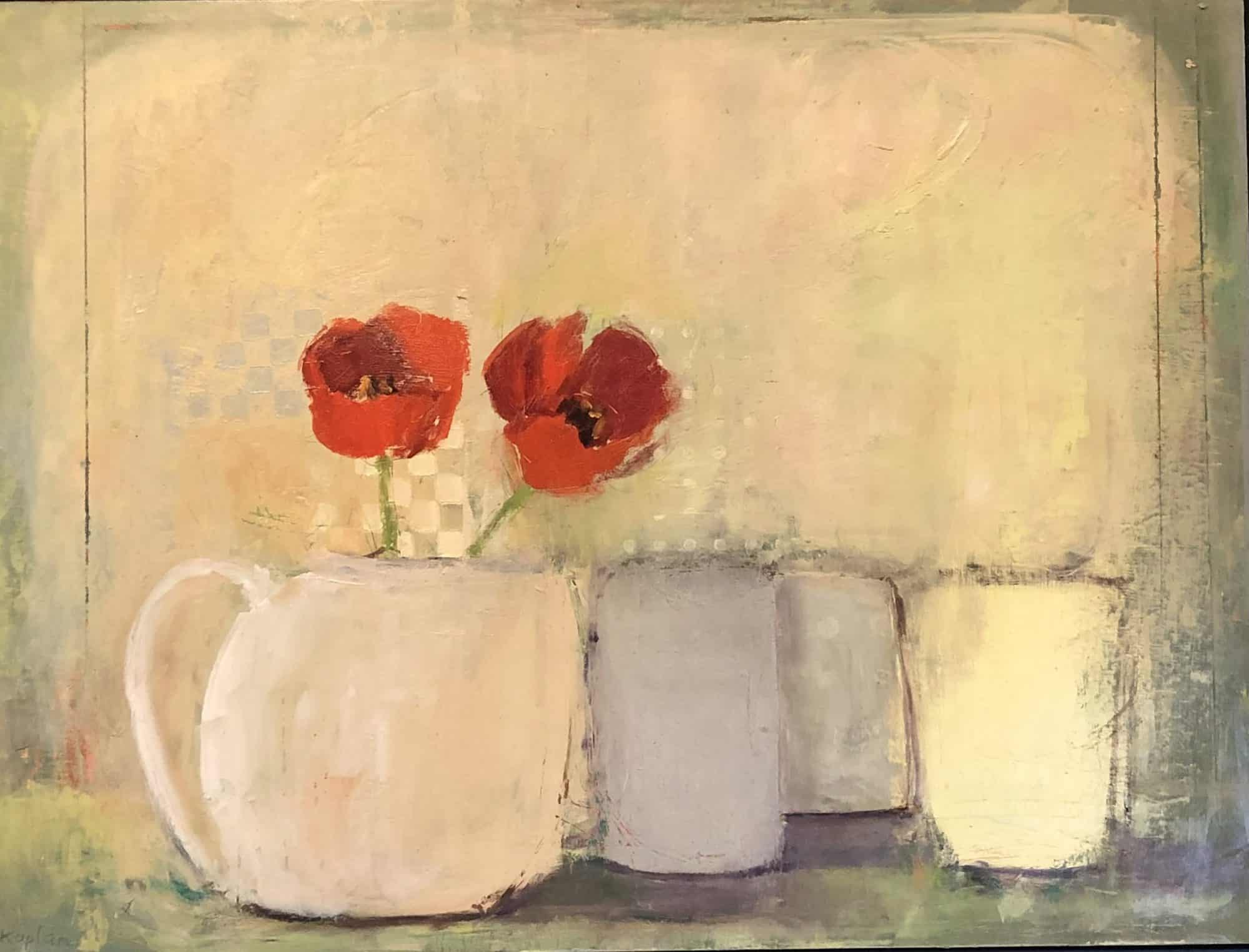
In my paintings I like to cycle between painting from observation and painting from imagination. And sometimes I like to combine the two. Painting flowers excites me, not only because they are beautiful, but also because I find that they spark my imagination. I like to invent scenes in which the flowers are the star. While in all of these paintings the flowers are painted from life, some of the scenes are invented, either completely or partially. For me, this is an exciting way to paint.
Over the years, I have used often used photographs in my wall hung sculptures. Though I don’t often exhibit the photos on their own, I put this series together in 2017 when Tompkins County was celebrating its bicentennial. The Rails to Trails Conservancy is devoted to converting old railroad beds into hiking and biking trails all over America. Here in Tompkins County, we are lucky to have many of those rail trails in our own back yards. I have spent many hours walking there – from the Finger Lakes Trail toward Willseyville to the Jim Schug Trail in Dryden to the eight miles of Black Diamond Trail from downtown Ithaca to Upper Taughannock Falls State Park and more. I am please to share some of the images captured on these walks across the seasons.
Right now, I am getting ready for a solo show in March and April of 2022 at the Geisel Gallery in Rochester, NY. That exhibit will feature photo sculptures inspired by my hikes on the Finger Lakes Trail. You can enjoy some of those pieces on my website, www.evasculpture.com.
Click here for more information about the history of railroads in Tompkins County.
Unspoiled is one of a pair of paintings that I made in response to an ugly disaster. On April 20, 2010, the oil drilling rig Deepwater Horizon, operating in the Macondo Prospect in the Gulf of Mexico, exploded and sank resulting in the death of 11 workers on the rig and the largest spill of oil in the history of marine oil drilling operations. For weeks volunteers worked tirelessly washing oil off of shore birds, saving as many as they could. This was the painting that showed the pristine beach before the spill and its companion showed the water and beach despoiled and littered with oil covered dead birds. At that time, only the second painting got into the show in the gallery, while this one stayed in the studio, biding its time, waiting for its turn to celebrate the beauty of nature unspoiled.
Slea Head is a painting that I started long ago in 2001, after a three week painting trip to Dingle, on the west coast of Ireland. Slea Head is one of the many headlands in that rocky coast. A patchwork of sloping sheep meadows juts out above the Atlantic Ocean and ends in a steep cliff. I went to Slea Head on a day of cold mist and drizzle, bundled in warm fleece, sturdy raincoat and rain-pants. I drew with my sketch book protected inside a large clear plastic bag. When I returned to Ithaca, I started the painting in my studio. It remained hanging there, unfinished, because I thought it was lacking something. Two decades later, I could finally see – it needed less, not more, and I removed a strip of land, essentially bringing the viewer closer to the brink of the cliff, to look down on the beach below.
Twin-lens reflex camera: Preparing to make an exposure
Twilight
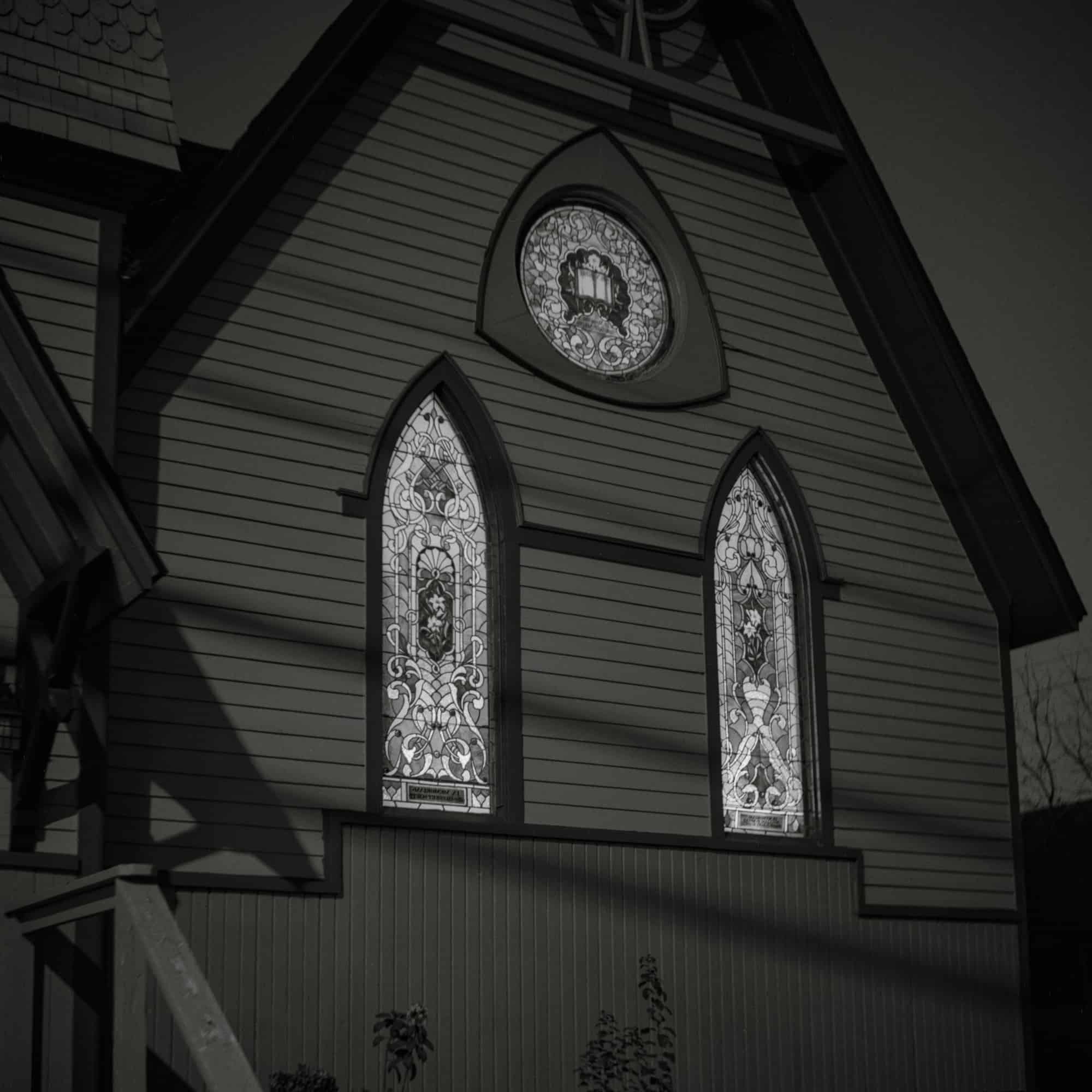
St. Thomas Episcopal Church, Slaterville Springs
I have been studying digital photography at Tompkins Cortland Community College every year since 2005. This past autumn I expanded my experience by working with film. With a medium format twin-lens reflex camera, borrowed from TC3, I spent the semester making photographs, one twelve-image roll of film at a time. Much of my time was spent remembering the settings I needed to make before taking each picture. First use a light meter (or an iPhone app) to measure the available light. Then set the preferred lens aperture (opening) for the exposure, set the time for an exposure at that aperture, focus the image, cock the shutter, release the shutter, and remember to wind the film before setting up for the next picture. I think I made every possible mistake, but practice helped. I learned how to develop the film, make prints in the darkroom, and scan negatives to edit and print digitally.
I took the pictures in this collection as a response to our final assignment: twilight photography. I chose places I know well. For a short period of time just after sundown, natural light and artificial light often complement each other. When I look at the photographs during what appears to be another spike of Covid, I see something else. The lights are still on.
I made these photographs in the spring of 2021in a spirit of optimism at the upturn in recent events; vaccines were rolling out, the end of the pandemic was in sight, a new president was about to unite our divided country. I began taking morning walks through Ithaca neighborhoods, marveling that everything appeared charged with a new beauty. The houses, the light, the blossoms—even the cars—appeared radiant to my hopeful eye. Alas, my enthusiasm was premature. We know now that we have more work to do. The photographs are a reminder—eventually, better days will come. Nine images from this series appear in SOAG’s January show,
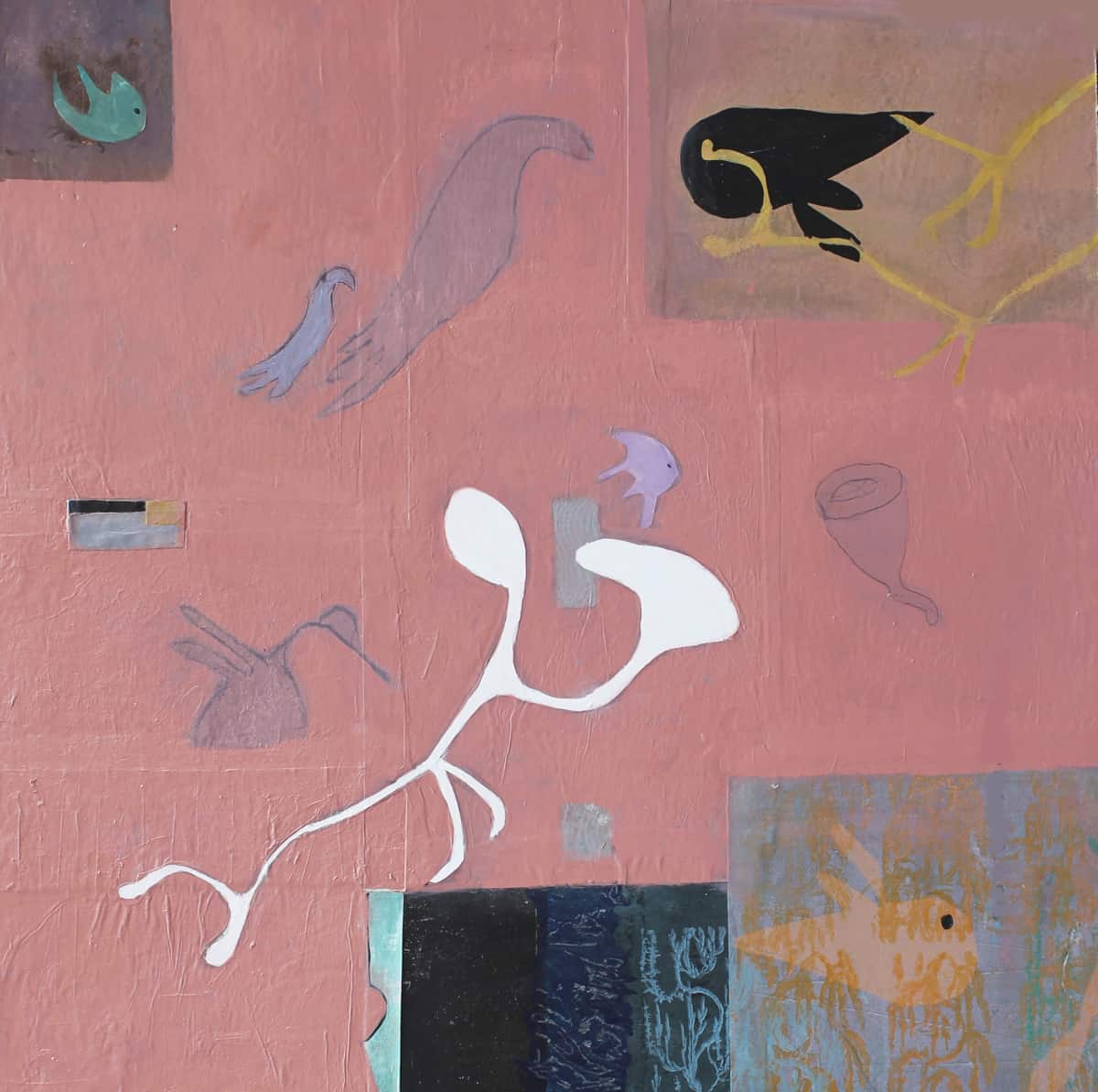
This painting is about the fascinating forms of life in prehistoric times. The plant life and animals that existed at that time are so mysterious and beautiful. The technique I used to create this piece is gel print collage. The process starts with printing many shapes and textures on single pieces of paper. After a number pieces are completed, they are assembled into a composition. Many unexpected correlations emerge into unique compositions that are not preconceived. There is an element of chance at work in the formation of the final result.
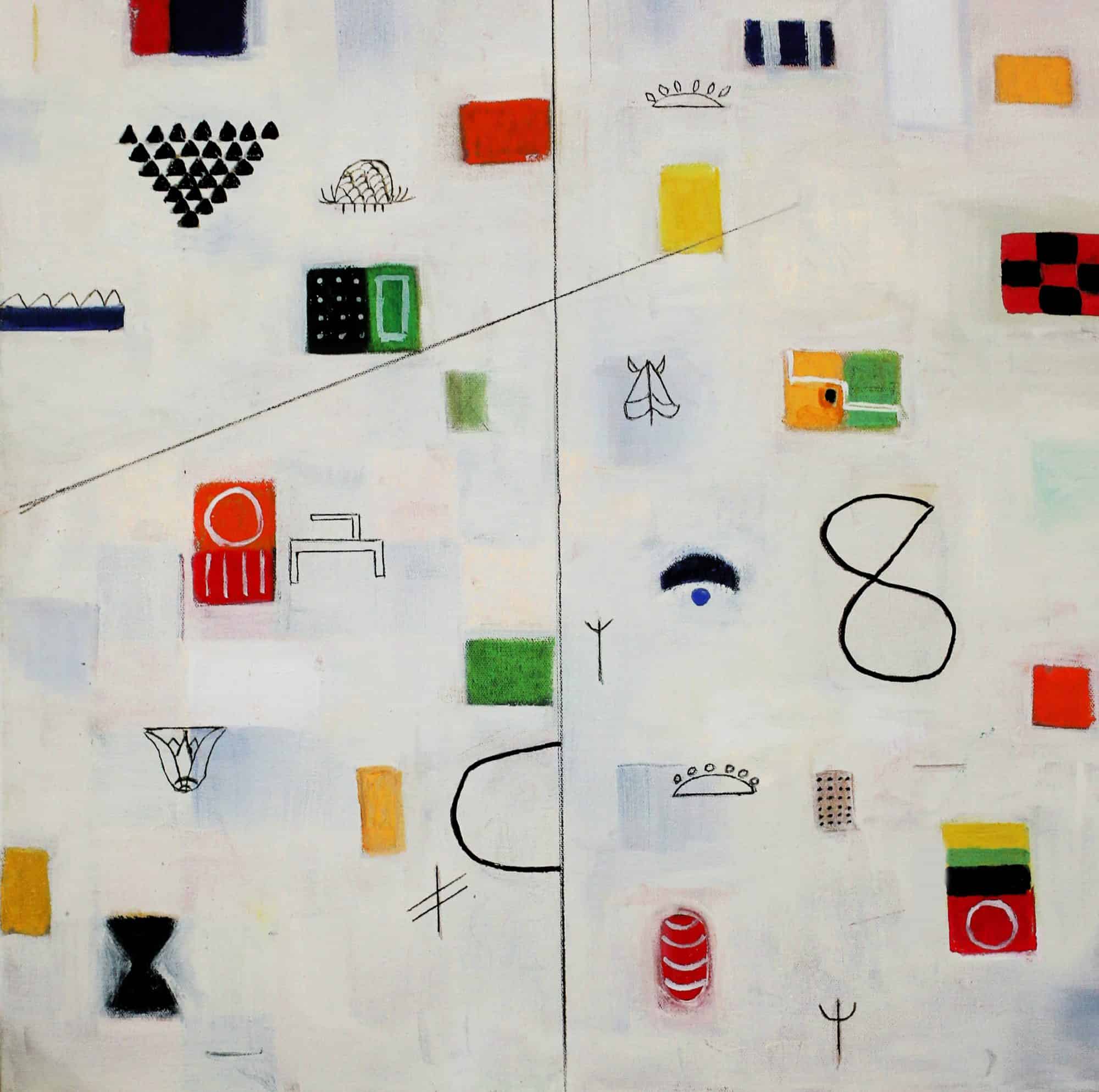
This painting is the result of restricting my color palette to yellow, yellow orange, green, red, and blue violet. All the colors are of high intensity making a bright, joyful array of colors. Additional interest was created by adding drawings of various shapes and symbols to the background. The result is a striking and cheerful painting. Thus, the title Upbeat.
Five Pieces in the Shape of a Pear… This was an exploration through levels of representation / modes of seeing. It began with a photograph in which I captured a pear in a glow of late morning sunlight on my kitchen counter (Pear I). Using that as my model, I painted a realistic watercolor of that photographic image (Pear II). I showed my painting to a friend who didn’t quite like it (why, I can’t recall!) so thought I’d try again, but I found that I had “used up” that mental image of the pear… its energy had gone into the first painting and I couldn’t recapture it. So instead, I distilled the pear, so to speak, and created a more simplified image (Pear III). Intrigued by that process, I repeated it (Pear IV) – this time propping the first painting on the counter, and stepping away to the far end of the kitchen, sans glasses, (a distance of nearly 20 feet) to make another watercolor sketch. Finally, I took another step away, from realism into a digital abstraction of the pear on the counter (Pear V), using Pear IV as inspiration.
I found it very interesting that each concept of the pear on the counter had only so much energy to contribute, that once it had flowed from mind through hand to paper, I had used it up, and no longer could – or wanted to – recapture it: a little like rubbing a wand on a cat’s back and then releasing the spark of energy that builds up, by grounding the wand. This is something I have noticed a number of times over the years (in my art, not so much with my cat…); I wonder if it reflects something about the creative process… or if it’s just me!
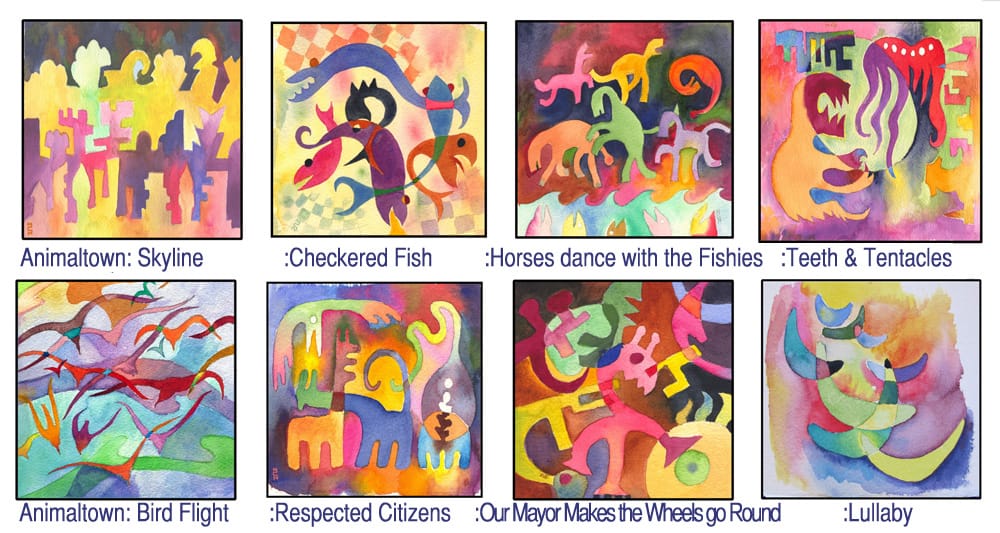
A few year ago, wanting to play with overlays of contrasting and complementary watercolors, I pencilled a doodle of whimsical shapes, then filled in all the spaces thus created. I used both blends and contrasts and enjoyed the exercise, to the point that I ended up with a whole series of these little paintings. These became the “Animaltown” series in my mind, because most of them involved doodled animal shapes. Naming each became a very entertaining part of the process, as I began imagining how each piece fit into the world of AnimalTown.
These eight pieces are now on view at State of the Art Gallery, as part of our first show of 2022: “The More You Look the More You See”, with work by ten members of the gallery. The show runs through the month of January.